THE DENTISTS LEGAL RESPONSIBILITIES TO THE PATIENT
CH. 4:
Proper Licensing is expected of the dentist and auxiliaries by their peers and their patients alike. The dentist and his/her auxiliaries are responsible for their actions and the results of those actions. They must only practice what is legally allowed, in accordance with their state and licensure. Continuing education is required for the dentist and auxiliaries to keep their licensure current and their education up to date.
Dentists are required to keep up with current changes related to their area of dentistry and use their continuing education requirements to continue and keep current their education. They must stay up on new developments in their field of practice and possess care, use their best judgment, and reasonable skills when treating their patients.
Dentists are often expected to be perfect by their patients, however the legal system understands that the best judgment and reasonable skill found in one dentist can be vastly different in another. Some dentists tend to be more reserved in their treatment, whether they are trying to save the patient money or trying to save additional tooth structure, where as another dentist wants to offer his patients only the very best options available, which often tends to raise the cost to the patient exponentially.
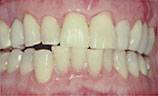
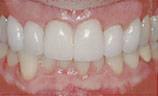
Before Porcelain Veneers After Porcelain Veneers
For instance a patient presents with decay on #8 and #9 (their two upper front teeth). The decay is large but one dentist feels it can be restored with a composite (tooth-colored) filling, which is cheaper and will save more tooth structure than any other alternatives. However another dentist feels that the best treatment would be a porcelain veneer on both teeth, which will strengthen the remaining tooth structure and the patient will have a beautiful restoration that no one, except possibly a dental professional, will be able to see. However the cost will be 3-4 times more for the veneer than the composite fillings. Both are excellent restorations and neither dentist is wrong in their recommendation. In this case it is up to the patient to choose which they feel is the best treatment for them. Often financial constraints play a large role in most patient choices, so it is fortunate for patients when they have a dentist who might present them with more than one option for treatment, one lesser expensive and one more expensive treatment.
Auxiliaries are also legally bound to possess and use standard skills, care, and judgment possessed by peers in their same community, which they are required to update each year through continuing education courses.
The dentist must do only those things consented to by the patient:
Consent is defined as permission given to perform recommended treatment. Documentation is the best way to avoid legal problems with patients. No matter how many consent forms are signed by a patient, the court will take into consideration that most people put their signatures on a piece of paper without fully understanding what they are agreeing to. And dental terminology feels very foreign to patients which a judge will also take into consideration.
There are FIVE requirements that make consent valid:
1. The consenter must be legally competent
2. Consent must be "informed"
For instance a very nice lady who a dentist had been seeing for years decided to have a implant placed in her jaw by an oral surgeon. She was told all of the risks, and ended up with nerve damage on one half on her lower face that is and will continue to cause her pain for the rest of her life. While trying to treat the pain with prescriptions pain killers, she became addicted to pain medication and has ended up in divorce, lost her job and her children. This is a very tragic story that is very uncommon.
It is also important not to assume a patient does or does not have the money for treatment. A dentist cannot offer to extract a tooth and not offer a root canal for a patient purely on the basis that they have no car or home or they come in looking ill-kept and their clothes have holes in them and are dirty. The dentist must always offer treatment options whether it be to have a root canal or an extraction or do nothing. It must be the patient's choice to make.
Language barriers must be broken down when informing a patient of their treatment options, and is an obstacle in dental offices that do not have someone who can interpret for the dentist.
3. Consent is for a particular treatment or series of treatments
Often a patient may come in for treatment on just one tooth or maybe they may have many dental needs and a treatment plan is prepared and signed by both the patient and the dentist. If a single treatment is agreed upon, then the consent stops after that treatment is complete. However, if a treatment plan is created, both parties agree to see it through to the end. In other words the patient agrees to let the dentist do the treatments on him or her and the dentist agrees to perform the treatment on the patient. In the case of the patient, he or she is not agreeing to do the entire treatment with the dentist and can choose to go elsewhere to finish treatment if he or she desires. Often a dental office will receive payment for an entire treatment plan before it begins, so that the patient will see the treatment through to completion.
4. The dental act/treatment must be legal
5. Must not be obtained by fraud, deceit, or trickery
PARQ – When a dentist discusses treatment options with a patient, it must be documented. However, it would take a lot of writing to document each person's part of the conversation. PARQ has been created to be written in the patient treatment notes and imply that each of the following issues have been discussed. Therefore the entire conversation no longer needs to be documented, and it has been shown that too much documentation can cause problems in court, because what is not written in the chart is assumed to have not been discussed with the patient. So too much writing is bad and too little writing is bad. A very fine line as you can see. In the end, as a dental assistant we have the luxury of leaving the extent of charting up to the dentist who must read and sign what we write. If the dentist wants more written they can either do it themselves or ask the dental assistant to provide more detail.
So what does PARQ mean? It stands for the following words.
· Procedure: The patient was advised of the recommended treatment and what will/would take place.
· Alternatives: The patient was advised of alternatives or options for treatment.
· Risks: The patient was advised of any risks from the recommended procedure and/or treatment options.
· Questions: The patient was given the opportunity to ask questions, to ensure (s)he completely understood the doctors recommendations and what can be expected from all parties and all treatments.
Written Consent
Consent must be in writing when any of the following may occur.
· New drugs are to be used
· Experimentation or clinical testing is involved
· A recognizable patient photo is to be used
· General anesthetic is to be used
· Minor children are going to be treated in a public program
o Like the kids that come to LCC clinic from local schools
· Treatment will take more than 1 year to complete
Dentist Must Not Abandon their Patient's
A dentist MUST have coverage when he/she is out of town or otherwise unavailable to his/her patient's "of record". This does not include any possible new patients or patients who have never been seen by the dentist and may walk by the office hoping for emergency treatment.
As a scheduler in a dental office it can be a problem to find a space to place emergency patients of record in a very busy schedule. But when there is a patient in pain or who has had an accident, the dentist must find a time for them in the schedule. It is recommended that there be a 15 minute space saved in the morning and afternoon schedule to place emergency patients. This does not mean that the dentist has to treat whatever the problem is that day, but they can get the patient out of pain, diagnose the treatment needed, and effectively schedule the patient for treatment as soon as possible.
Withdrawals from a case:
Even if patient has not paid for their previous treatments, the dentist cannot abandon them by denying treatment or even by telling then there are no openings for the next few weeks or months. Avoidance is no more legal than denial of service when it comes to patient abandonment by their dentist.
This doesn't mean that a dentist is destined to treat a patient forever, who will not pay for the agreed upon services, or is not in compliance with the recommended care. A dentist may withdraw from the care of a patient under the right circumstances.
If a dentist chooses to withdraw from the care of a patient, they cannot do so in the middle of treatment, unless they meet at least three of the criteria below. Treatment is considered to be completed when a treatment plan is finished. This means that if a patient has 3 fillings that need to be completed at future appointments, they are still in the middle of treatment.
I
There are 3 requirements for withdrawal of service by the dentist (can withdraw before completion of treatment if all 3 are met):
1. Withdrawal of care must be in writing to withdraw from a case or patient
2. Letter must be sent by certified mail and return receipt is required
3. Copy of the letter and receipt from the certified mail should be kept in patient records/chart.
REVIEW pg 71 for all patient withdrawal letter contents.
The Dentist Must Achieve a Reasonable Result
Perfect treatment is not expected by most people, but some patients will always anticipate a certain result no matter whether you explain what to expect or not.
A dentists treatment results must compare with what a patient would get at another dentist of the same specialty and under the same circumstance.
It is extremely important that the Dentist and the Auxiliaries never make guarantees regarding results!!!! Results depend on the dentists abilities (for example some are more artistic than others), the patients compliance, and the very nature of teeth themselves to react within a range of expectation.
Part of consent is informing the patient of risks or making them aware of possible difficulties. This helps the patient to have realistic expectations.
Unrealistic Expectations: Despite the dentist's best efforts, there will always be patients who have a picture in their mind of what their teeth will look like when the dentist is done with treatment.
This is a common problem with people who get a new set of dentures or a new partial denture. They expect to see the same person in the mirror that they saw the last time they had perfect beautiful teeth. Dentures cannot restore youth or deteriorated bone structures. Patients who are new to dentures also must be advised that their new teeth will not be a replacement for their natural dentition. Every new denture patient has a learning curve when it comes to speaking, pronouncing words and eating. These patients will also loose out on a lot of the taste and flavor of their food that is enhanced by the natural tissue that will now be covered by the plastic denture. Recently I heard about a case where a patient had had the flu and vomited his denture into the toilet without realizing it. He flushed the toilet. Once he realized what had happened he wanted his dentist to give him another denture for free, because the dentist had not warned him about vomiting with a denture in place and the possibility of it coming out "during the act".
A frequent source of lawsuits seen by a local attorney is patients expecting perfect white teeth with just a cleaning. This is not realistic. Patient's teeth have very individual colors and stain. Some stain is removable and some is not. As dental assistants, we will be polishing patient's teeth to remove stain. However, it is imperative that our patient's understand that some stain may not be removable and polishing a person's teeth will not change their natural color.