|
FN 225: Nutrition
Noy Rathakette, Ph.D. Health Professions Division Lane Community College Eugene, Oregon LECTURE 1A CORRECTIONS / CLARIFICATIONS:
FORUM to be posted Monday afternoon (Be certain to read what it says above about required FORUM participation):
While looking at this lecture (and listening to a part of it that comes later), fill out the Lecture Outline in your packet that begins on page 9. LECTURE 1A: Chapter1- Food Choices and Human Health Begin by looking at how this
LECTURE OUTLINE is organized in your packet.
I The Science of Nutrition
LECTURE 1B will
continue
with Chapter 1.
II Placebo Effect III Identifying Valid Nutrition Info in the News: Scientific Research IV Identifying Nutrition Info that is unreliable (not valid) & that should make you suspicious V 4 Guidelines for Evaluating Nutrition Info on the Web (from the LCC library) I The Science of Nutrition A.
Definition of "Nutrient" for EXAMS-
a chemical substance in food
that
is required by the body to
provide energy, give the body structure and/or help it work. USING THE ABOVE DEFINITION,
which of
the following is a nutrient-
carrots, vitamin A or both __________
Click here if you think the answer is carrots. Click here if you think the answer is vitamin A. Click here if you think the answer is both. The 6 categories (types) of nutrients for humans: 1.
carbohydrates (sugar, starch, fiber)
2. fats 3. proteins 4. water 5. vitamins 6. minerals Which of these categories do you think should be first? Click
here is your answer would be water.
Click here is your answer would be protein. Click here is your answer would be one of the other categories. The categories of nutrients that have energy that humans can use are (1) carbohydrates (starch and sugar but not fiber), (2) fats and (3) proteins. I'm hoping that these Lectures help you understand the material, not only to help you be successful on tests, but also to deepen your understanding so you'll remember it even after the course is over. 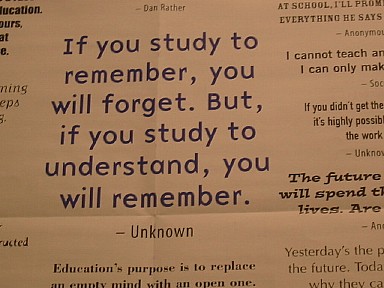 The above poster was on the office door of a colleague, Steve McQuiddy. B. MACRONUTRIENTS (not defined this way in our text): 1.
carbohydrates (sugar, starch, fiber)
2. fat 3. protein 4. water Which of these macronutrients can be broken apart to yield energy for the human body? (see above) 1.
Vitamins.
Vitamins A, E, D, K and C are examples of vitamins. Also, there are 8 B-complex vitamins and they are thiamin, riboflavin, niacin, pantothenic acid, biotin, folate, B12 and B6. 2. Minerals. Examples of minerals include calcium, potassium, sodium and iron. Neither vitamins nor
minerals can be broken
apart to yield energy for the human
body, although vitamins DO have
energy. More about this later.
D. Is a potato a carbohydrate? _________Why or why not? Click
here if you think
the answer is No.
Why is it NOT appropriate to call a potato a carbohydrate? You should now be able to answer this. Speaking of potatoes, each week The New Yorker magazine has on its back page a cartoon in need of a caption. Readers submit a caption, they choose 3 finalists and then readers vote on their favorite of the finalists. These were THE FINALISTS in their November 19, 2007 issue: 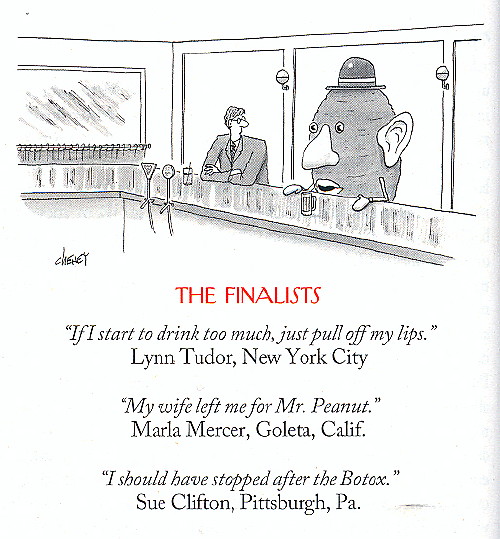 When you submit the Study Questions for Chapter 1, you'll get a chance to vote on your favorite caption. E. What is the definition of a nutrient? Use the definition at the start of this lecture. |
| F.
Definition
of
an organic nutrient- A
nutrient (or substance) containing
carbon to carbon bonds which can be broken apart (also called burned)
to
release energy. (A bond is a link between two elements.)
A colleague, the chemistry instructor Gary
Mort, said that pictures like the above are taken with plain polarized
light. The crystals
act as diffraction gratings and since they are at different angles, the
crystals show up as different colors. Many organic molecules can do
this.An element is a substance that can't be separated into smaller parts. Examples of elements include carbon, hydrogen, iron and calcium.) Here
is the Periodic Table of all the elements:
On the Periodic Table below,
find the following elements:
carbon [C] hydrogen [H] oxygen [O] iron [Fe]. 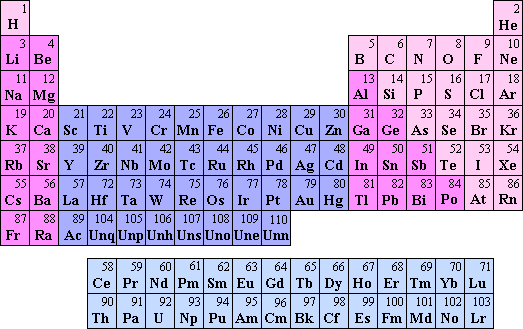 Glucose (shown below) is an organic substance because it has carbon atoms bonded to other carbon atoms which can be broken apart to release energy. 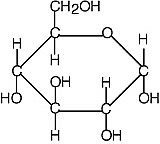 A MOLECULE OF GLUCOSE Is C02 an organic substance? Use the definition above (definition of an organic nutrient) to answer this. [C02
(carbon dioxide) is a combination of one atom of carbon bonded to 2
atoms of oxygen.]
Click here if you think C02 is an organic substance. Click here if you think C02 is NOT an organic substance. Why or why not? You should be able to answer this now, but you may have dificulty if you did not click just above where it says click here. Send me a message if you're still confused. Four of the 6 categories (the ones in a green font) of nutrients are organic. 1.
carbohydrates
(sugar, starch, fiber)
2. fats 3. proteins 4. water 5. vitamins 6. minerals The vitamins in our food ARE organic and contain energy. Why can't our bodies release this energy that is in vitamins? One reason we canNOT release the energy in vitamins is that we don't want to! Releasing the energy in vitamins would require breaking the vitamins apart. Then we would not have vitamins available to do for us what we need them to do, such as help us heal (vitamin C) or see (vitamin A). So we don't make the enzymes needed to break apart vitamins. 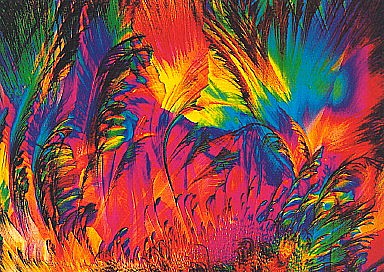 Photomicrograph of Vitamin C by Michael W. Davidson, 1990 Center for Materials Research & Technology and Institute of Molecular Biophysics The Florida State University, Tallahassee |
|
G. Definition of an inorganic nutrient- A nutrient without a carbon to carbon bond and it cannot be broken apart to release energy. Which of
the 6 categories of nutrients are inorganic? It's the two that are left
over from the list.
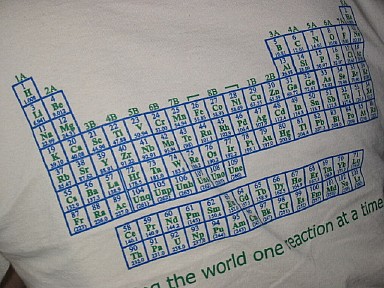 Above is another look at the Periodic Table of the Elements. Connie Rowlett, the Administrative Assistant in the Science Division, is wearing the shirt. As you can see with the image below, vitamin A has many carbon atoms bonded to other carbon atoms so it is organic. Iron, on the other hand, is a single element. See if you can find iron (Fe) on Connie's Tshirt above. 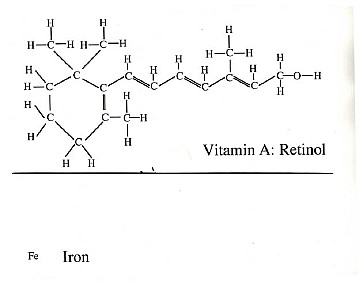 Your Turkey Cheese Frank fell into the barbecue and is now nothing but ash. Which of the six categories of nutrients is this ash composed of? The ash is composed of minerals. What did the carbohydrates, proteins, fats & vitamins become? All of these are organic and they burned up and became: 1. heat
2. carbon dioxide (which went into the air) 3. water (which evaporated) H. Definition of a Calorie (kcal)- a measure of how much energy (or potential heat) in a food 1 gram carbohydrate OR protein has 4 Calories (kcal) 1 gram fat has 9 Calories (kcal) (a gram is about the weight of a paper clip) |
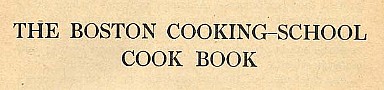 This 1912 cookbook is by
Fannie Merritt Farmer. Notice below how food was
classified. This more accurately should have said "NUTRIENTS are
classified as follows":
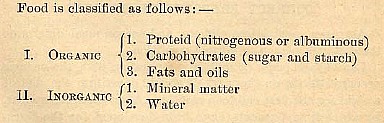 Which of the 6 categories of
nutrients was missing back in 1912? ________________
A form for your Food Record is on page 3 of your packet. #12 on that page says that "After Week 1, look above Week 1 in our Moodle class for 'Instructions for Diet Analysis Using the Internet'". If I forget to make the instructions available, please remind me. |
|
II
Placebo Effect
(Definition of
placebo- NOT a real treatment but it might induce body's natural
healing process.) Consider the following: 500 women were divided into 2 groups. One group took 1200 mg of calcium a day and the other took a placebo. After 3 menstrual cycles, the calcium group reported a nearly 50 percent drop in 4 major PMS symptoms: mood swings, pain, water retention and food cravings. The placebo group saw a 30% decrease (Newsweek, Special Issue) Why is this an example of the placebo effect? It is an example of
the placebo effect because BOTH groups saw improvement, even the
group receiving the placebo.
For the next section, watch the "Healing Video Clip" below. It will help you fill in some blanks in your Lecture Outline. In this clip, as well as most future clips, I'm giving a lecture during the winter of 2007 when I taught this class on local cable TV. There is no sound on the last 20 or 30 seconds of thus video clip, but you will see some text. It ends with the words "The end of this video clip". |
| Healing
Video Clip (Beth's) |
| The two browsers that seem to be the fastest ways of
accessing the
video clips are Safari
on a Mac and Internet
Explorer on a Windows-based computer. A dial-up Internet connection is not fast enough to watch many parts of the Lectures. If an approximately 10-minute movie isn't showing up just above on your computer, you may not have the latest version of QuickTime on your computer. Click here to download the newest version of Quick Time. (If you're viewing these
lectures at LCC, you can watch the Video Clips on the library's
computers or on the computers in the Computer Lab in Building 4, room
201. You will probably not be able to view the Video Clips on the
computers in the Science Resource Center.)
The movie may appear jerky the first time through. That's because it's "buffering" onto your computer. It should be smooth the second time through. Viewing the video clips works best with the following browsers: Safari if using a Mac
Explorer if using a Windows-based computer I don't understand why, but Firefox does NOT work. |
What
is
the definition of a "quack remedy"?
A placebo effect is not
exaggerated, deceptive, money-making or harmful, but the
benefits
ARE likely temporary.
It is something that is documented during research to determine
if a treatment is more effective than a placebo treatment. The
participants in the research are told that they will be receiving the
actual treatment OR a placebo treatment.
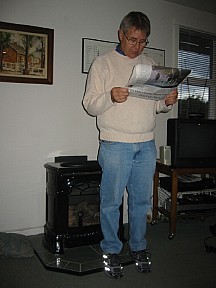 Here is Beth's husband
warming up
in front of our gas stove and he thinks he IS warming up.
But you'll
notice that he is receiving a placebo
benefit because the stove is NOT ON.
Just standing there induced his body to do activities that made him feel warm, like increasing circulation. But it's definitely temporary and we would NOT be happy is someone took our money for that stove telling us we'd always receive a benefit even without putting a gas line to it then turning it on. This is the end of Lecture 1A. Also watch Lecture 1B during week 1. |
Incorrect. Carbon dioxide has just one carbon atom, so it is NOT considered organic. An organic nutrient (or an organic substance) contains carbon atoms bonded to carbon atoms which can be broken apart (also called burned) to release energy.
Click here to
return to the Lecture.