Some
Results from SQ Week 2
(LECTURE 3B follows the results.)
For
which of the following nutrients was your intake UNDER the
TARGET Recommendation?
(%) |
|
| Protein | 19 |
| Total Fiber | 56 |
| Saturated Fat | 33 |
| Vitamin E | 74 |
| Vitamin B6 | 44 |
| Vitamin B12 | 33 |
| Calcium | 56 |
| Magnesium | 56 |
| Iron | 63 |
| Zinc | 59 |
| Selenium | 15 |
| Potassium | 75 |
| Vitamin D | 67 |
| None of the above.
I was above my “Recommendation or Acceptable Range” for
all nutrients. |
0 |
Which groups
were you UNDER the target recommendation? (Select all that
apply.)
(%) |
|
| Grains | 44 |
| Vegetables | 65 |
| Fruits | 56 |
| Dairy | 63 |
| Protein Foods | 33 |
| None of the above.
I was above my target recommendation for all groups. |
0 |
|
FN 225: Nutrition
LECTURE 3B: Wilbur
and Solar PowerTeresa McFerran, M.S., R.D. Health Professions Division Lane Community College Eugene, Oregon |
The Lectures NEXT week (Week 4) are longer than usual, so please plan your time for next week accordingly. FORUM: 1. As you can see in the above results from the diet analysis project, students report being low in many vitamins, minerals, and fiber. Pick a nutrient you were low in, and use your text (chapters 4, 7, 8, 9, 10) to identify good food sources of these nutrients. What is one realistic change you could make to your diet to increase your intake of one of these nutrients? For example, almonds are a good source of Vitamin E, 9mg for 1/4 cup. I like to incorporate almonds into my snacks (usually 1 oz, which is the size of a golf ball, with a piece of fruit). 2. As you can see in the above results from the diet analysis project, a large percentage of students report being low in vegetables. What kind of strategies do you use or could you use to eat more vegetables? Note: Overall, students are low in most food groups. I find that when I review food records from students, they don't report eating much of anything. If you don't eat, it is going to be hard to meet the recommendations for nutrient intake. Students also reported being low in dairy, but from my experience you don't need 3 c. of dairy to get the nutrients like calcium that you need. Usually 2 c. is plenty as long as you are meeting the recommendations from the other food groups. Lecture For this lecture, have in front of you the "Wilbur Drawing" and "Your Notes about the Wilbur Drawing" and "Wilbur and Solar Power" in the lecture outline for Week 3 (which you can print off of moodle). The "Wilbur Drawing" in your lecture outline is subtitled "How Energy Goes from the Sun to Human Cells". I will be using corn as a specific example of this, but it's what happens in all plants. It's sort of hard to read the bottom of the "Wilbur Drawing. It says in cells everywhere in body. 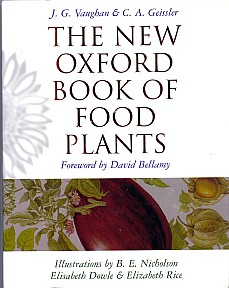 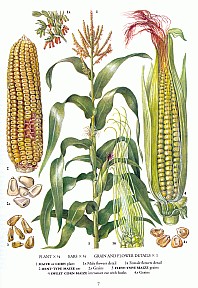 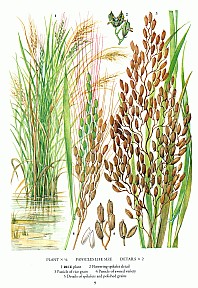 I chose corn because it's a crop native to the Americas. The illustration on the right shows rice, which would be better used to illustrate this process if we were in Asia. The other book I used was Isaac Asimov's book Photosynthesis. He was a Russian-born biochemist and writer who died an American in 1992.  Isaac Asimov is the author of 300 books, many of them science fiction.  5 steps of the Wilbur Drawing
The two videos below will explain these 5 steps in more depth. |