|
FN 225: Nutrition
Teresa McFerran, M.S., R.D. Health Professions Division Lane Community College Eugene, Oregon LECTURE 4B:
Carbohydrates
|
Organic formula a sweet alternative, By Julia Moskin. The New York Times, May 19, 2008. EXAM during Week 5, so study: SQ Week 3
SQ Week 4 L3A L3B L4A L4B FORUM:
This lecture will cover the following topics: II Processing of Foods with Carbohydrates III Digestion and Absorption of Carbohydrates IV In the
Body: Glucose As Fuel
Your LECTURE OUTLINE describes the definitions we'll use of foods that are WHOLE, PARTITIONED or REFINED. Sometimes other definitions are used, but these are the ones that we'll use. When making juice from something like an orange, the main thing that is removed is the fibrous part of the orange. From these
definitions, see if you can pencil in what you think the
listed foods in the lecture outline would be, WHOLE,
PARTITIONED, or REFINED. Leave the
"wheat flour" one blank. You'll be able to fill it
in later.
Consuming lots of refined foods instead of whole foods can affect carbohydrate intake in two important ways. It can increase your sugar intake and decrease your fiber intake. When trying to determine if a food is high in sugar, you can look at the food label for grams of sugar. Keep in mind the sugar on a label does not distinguish between naturally occurring and added sugars. |
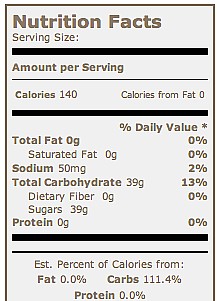
| Directly below are the Nutrition Facts for a
12-ounce can of Coke. Here the Serving Size
for the Nutrition
Facts is 12 ounces.
Fill in these above
values in the blanks of that part of your Lecture
Outline.
That 12-ounce can would have almost 10 teaspoons of sugar (39 grams of sugar divided by 4 grams per teaspoon). |
Directly below are the Nutrition Facts for a 20-ounce plastic bottle of Mountain Dew. Here the Serving Size for the Nutrition Facts is 8 ounces. If you drank this whole
bottle of of Mountain Dew, you would be
getting almost 20 teaspoons of sugar.
(31 grams of sugar divided be 4 = almost 8 teaspoons of sugar per 8 ounces. 8 teaspoons of sugar multiplied by 2.5 servings per bottle = almost 20 teaspoons of sugar for the entire 20-ounce bottle.) |
| |
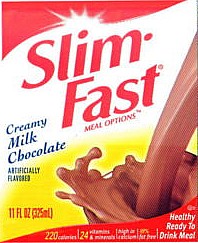
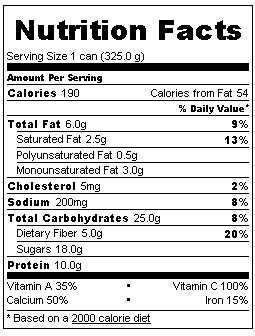
Directly below are the Nutrition Facts for a 12-ounce can of Slim Fast. How many teaspoons of sugar would that be equal to? I don't have a can in front of me so I don't know if some of that sugar is naturally occurring from lactose. The only way to know would be to look at the ingredient list to see if milk is in the ingredients. |
|
Watch the following
Video Clip to find out how many 1-teaspoon sugar cubes
are in this size Big Gulp container.
Video Clip: Big Gulpapproximately 6 minutes Big Gulp video |
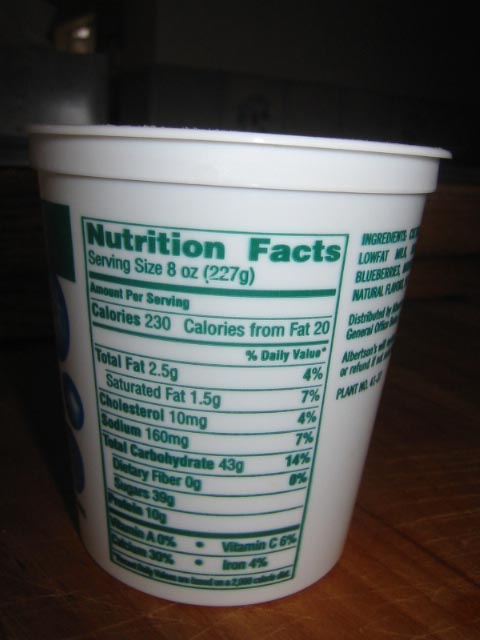
![]() Above are the Nutrition Facts for an 8-ounce serving of Blueberry Yogurt. The 39 grams of sugar shown on the Nutrition Facts are a combination of lactose in the milk, fructose and sucrose in the blueberries and sucrose in table sugar. The only way to know how much sugar is added and how much sugar is natural is to do a little detective work. |
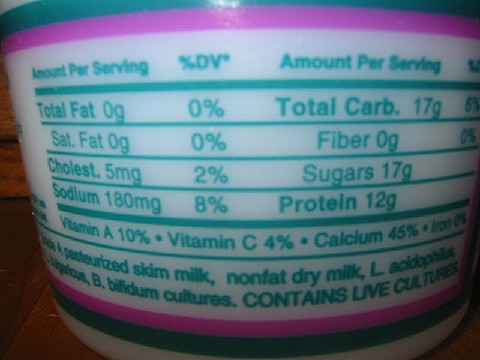
Above are the Nutrition Facts for an
8-ounce serving of Plain Yogurt. There is
no added sugar (because there are no added sugars in
the ingredient list) so the 17 grams of
sugar shown on the Nutrition Facts is
coming from lactose in the milk.
So you
might be thinking well how much added sugar do I
need in the first place?
The World
Health Organization recommends < 10% of your
total Calories coming from added sugar. This
would mean that someone eating a 2,000 Calorie diet
would want to limit their added sugar intake to 50
grams (about 13 teaspoons). Not much more than the
sugar found in a 12 ounce soda.
The American Heart Association a more conservative recommendation for maximum added sugar: Just 25 grams (about 6 teaspoons, or 100 Calories) for women, and 38 grams (about 9 teaspoons, or 150 Calories) for men. I don't
encourage people to keep track of their added sugar
intake (it would be almost impossible to do since
labels don't specify the type of sugar in processed
foods), but I do encourage people to focus on WHOLE
foods that are minimally processed and to consume
added sugars and foods with added sugars in
moderation.
|
D. Enrichment. Enriched vs. Whole Wheat Bread
| The lecture
outline tells you that if a food label
uses the term enriched, it means that
5 specific nutrients are required to be added to white
flour and its products as well as to white rice.
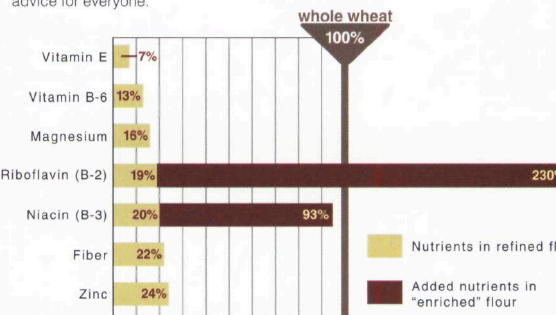
Those 5 nutrients are added at levels about
what they would have been before the flour or rice was
partitioned. The Enrichment Act requires that these 5 nutrients be added to all refined grain products before they are sold, so you only see in stores white flour that says "enriched". |
|
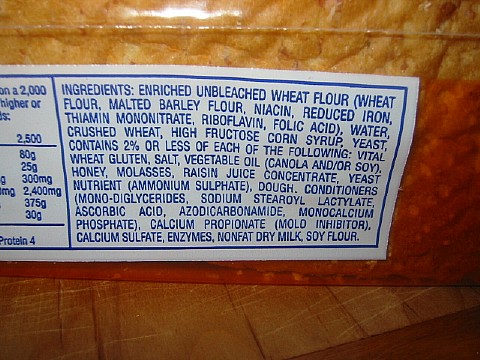
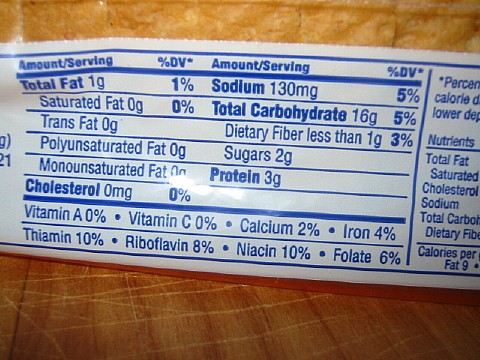
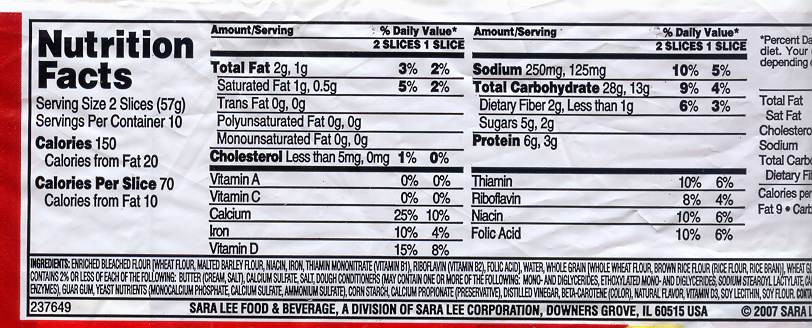
These days, many breads that are made entirely with WHOLE grain flour use "100%" on the label. But to truly know if a bread is WHOLE grain you need to look at the nutrition facts. 1. Make sure it lists a whole grain (like whole wheat) as the first ingredient, AND 2. make sure it is a good source of fiber (DV >10% for fiber). For more information on how to determine if grains are truly whole grain view this short powerpoint. |
| Now go back to the part
of the lecture outline where you're asked to
label whether you think the
listed foods are WHOLE, PARTIALLY
REFINED, or REFINED. What would you say
about "wheat flour"?
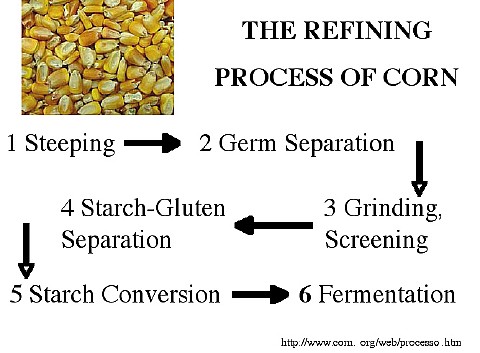
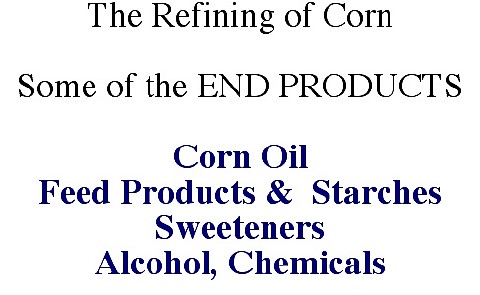
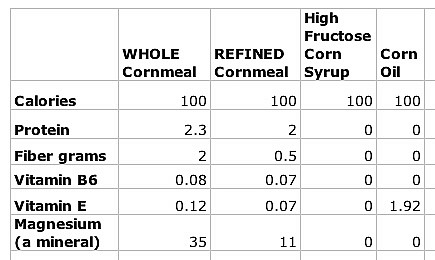
There are at least two reasons why processed foods are often cheaper than whole foods. One is that processed foods can be stored longer before they need to be purchased or used. The germ in whole wheat flour has beneficial fats in it that can go rancid if not sold and used right away. Fresh vegetables and fruits have enzymes in them that cause the food to decompose. While the processed foods can be stored longer, the processing cause them to lose MANY beneficial nutrients. A second reason why processed foods are often cheaper than whole foods is that processing can divide a food (like corn) into many parts that then can be sold individually. It's not the farmer who sees this profit.
|
| Refining is used to
obtain other additives used in food processing besides
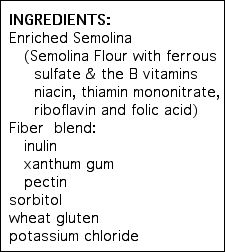
sweeteners. Three additives make up the "fiber blend" of the pasta on the right. All 3 of these additives (inulin*, xanthum gum and pectin) are non-digestible carbohydrates made by plants, but in the case of this pasta, it takes a factory to refine them from the plants, the way it takes a factory to refine table sugar from beets or corn. When I did a web search to find out where inulin is manufactured, I found 4 regions listed. The majority were in mainland China, some were in the U.S and others were in Australia and Vietnam. Persons choosing to eat foods with inulin should watch for signs of gas and bloating, which occurs in some people. Note that the pasta also has the additive wheat gluten. Gluten is a protein naturally found in wheat, but gluten intolerance is becoming increasingly common, including among people with diabetes. * "Inulin" is no
relation to "insulin". It
gets its name from inula, a large genus of about 90
species of flowering plants in the family Asteraceae,
native to Europe, Asia and Africa.
|
![]() The following website shows you an alphabetical listing of additives (including the sorbitol you see in this pasta) with an evaluation of their safety: CSPI's Guide to Food Additives (Center for Science in the Public Interest). What it says about sorbitol is: "Some
diabetics use sorbitol-sweetened foods because it
is absorbed slowly and does not cause blood sugar
to increase rapidly. Moderate amounts of sorbitol
are safe, but large amounts may have a strong
laxative effect and even cause diarrhea."
|
|
|
|
| III
Digestion
and Absorption of Carbohydrates After eating,
nothing needs to happen in the digestive tract to
the monosaccharides in a food like grapes because
they are already small enough and they are
absorbed as is.
Disaccharides in that grape or in a food
like milk are broken down in the
digestive tract to monosaccharides. Grapes
would have sucrose (in addition to glucose
and fructose) which would be broken
down in the digestive tract to glucose
and fructose, which would be absorbed into the
villi. The milk would have the disaccharide
lactose which would be broken
down in the digestive tract to glucose
and galactose. Starch in food
would be broken down in
the digestive tract to glucose molecules.
Fiber in food would
NOT be broken down in the
digestive tract because we don't have the enzymes
to do that.
|
|
The Video Clip below
shows Loretta Plaa, retired nutrition faculty at LCC
giving a very fun explanation of the anatomy of the
digestive tract.
Video Clip: Villiapproximately 12 minutes Villi video |
| Which foods listed below have carbohydrates
that need to be enzymatically digested? Click here if you think Table Sugar has carbohydrate that needs to be enzymatically digested. Click here if you think Butter has carbohydrate that needs to be enzymatically digested. Click here if you think Soybean oil has carbohydrate that needs to be enzymatically digested. Click here if you think Chicken has carbohydrate that needs to be enzymatically digested. Click here if you think Eggs have carbohydrate that needs to be enzymatically digested. Click here if you think Pinto Beans have carbohydrate that needs to be enzymatically digested. Click here if you think Spinach has carbohydrate that needs to be enzymatically digested. Click here if you think Peas have carbohydrate that needs to be enzymatically digested. Click here if you think Apples have carbohydrate that needs to be enzymatically digested. Click here if you think Pasta has carbohydrate that needs to be enzymatically digested. |
You should now be
able to fill in "B" and "C" of III in your Lecture Outline. If you
have questions about this post them in the
forum.
|
| There are two locations
in the body where bacterial
digestion of carbohydrates can be a problem. One
is the mouth
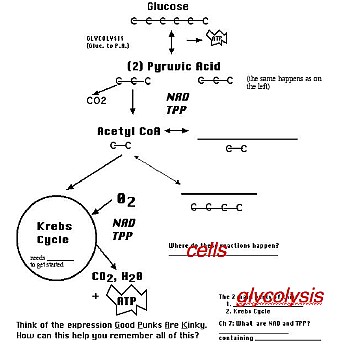
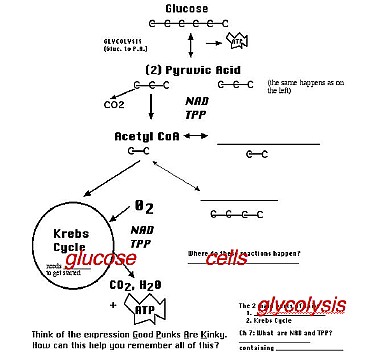
and there other is the colon (large intestine). As your lecture outline says, what happens in the mouth after eating foods containing starch or sugar is that the plaque bacteria eat and digest the starch or sugar. They then produce energy by anaerobically (without oxygen) breaking down the resulting glucose. The process of breaking down glucose anaerobically for energy is the glycolysis (shown in the image below). Use the image below to fill in some of the other blanks you will see on the last page of your lecture outline. The C on the image below = carbon.
Cellular respiration is actually step 5 of the
Wilbur Drawing. During cellular
respiration, glucose combines with oxygen
(and certain enzymes). This breaks apart the
glucose releasing energy as ATP and producing CO2
& H2O. |
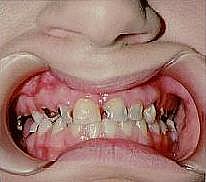
| What is left on the teeth
as a result of this anaerobic breakdown of
glucose is pyruvic acid. This pyruvic acid
destroys the enamel of teeth with the result being
cavities. A few of the ways to decrease your risk of cavities are:
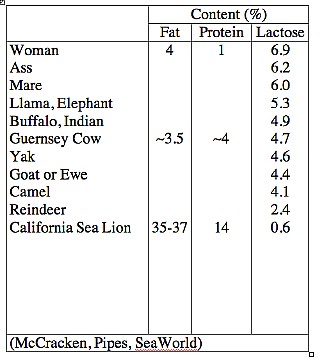
The second location in the body where bacterial digestion of carbohydrates can be a problem is in the colon. Humans, like most other mammals from buffalo to yaks, produce lactose for the milk to nurse their young. It gives their milk an appealing sweet, but not overly sweet, taste. (It has about half the concentration of sugar as the average soft drink.) This photo of a

nursing elephant, as well as the following photo,
was taken by Courtney Fitzpatrick, who grew
up in Eugene. As a doctoral student at Duke
University in North Carolina, her research took
her to Kenya.
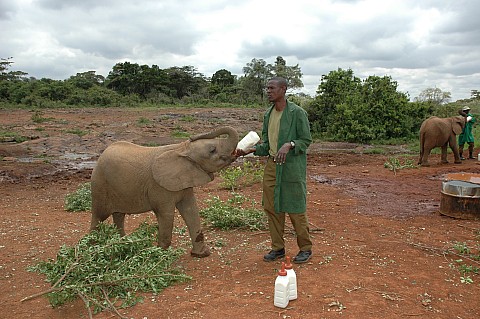
This is at the David Sheldrick Wildlife trust in Nairobi, an organization that cares for orphaned elephants and then eventually reintroduces them to a specific state park in Kenya. Apparently they have pretty high success rates, although it takes a huge amount of human hours to care for them! The enzyme lactase, made by a baby, breaks down lactose into two simpler forms of sugar (glucose and galactose), which are then absorbed into the bloodstream and provide glucose to fuel a baby's rapid growth. While fat in the milk can provide energy for the baby's muscles, as we've discussed, glucose is the only significant fuel the human brain and nervous system usually uses. Once a baby stops nursing, most slowly lose the ability to make lactase. While this condition is called lactose intolerance, it's the normal condition for most of the world. About 75% of the world's adults are lactase-deficient, including most Asians, Southeast Asians, Africans, Middle Easterners and Native Americans. Northern Europeans, among whom lactose intolerance is uncommon, have at least a 10,000-year history of dairying and milk consumption which is different from most of the rest of the world. A hypothesis is that at some unknown point in time, a mutation or adaptation occurred that enabled Northern Europeans to produce the enzyme lactase and digest milk as adults. Through natural selection, the frequency of the genetic trait for lactose tolerance increased in dairying societies because individuals with this genetic trait had the advantage of being better nourished. Not only did the milk provide protein, also their calcium absorption was increased by the lactose and the small amount of vitamin D in the milk. In societies living closer to the equator such as in Africa, the sun's ultraviolet light helped them manufacture vitamin D. In Northern Europe, cloud cover limits sunlight for much of the year. Human intestines are full of bacteria that are not lactase-deficient. The bacteria break down lactose because they want the fuel it can provide. This intestinal fermentation produces hydrogen and other gases and molecules that attract water. This can produce symptoms like nausea, gas, bloating, cramps and diarrhea. For a person with lactose intolerance, symptoms begin about 30 minutes to 2 hours after eating or drinking foods containing lactose. One term, a student told me that “lactose intolerance is one of those sliding scale things“ and she was exactly right. The severity of symptoms depends on many factors, including the amount of lactase a person makes and the kinds of bacteria they host. For these reason, not all people deficient in lactase have the symptoms commonly associated with lactose intolerance. We definitely do not need to drink milk as adults but what we DO need is calcium and some people find it difficult to get enough calcium without drinking milk. Later in the term, we'll talk more about getting calcium, but what will say is: Getting enough calcium if lactose intolerant:
|
|
After eating foods with carbohydrate, these carbohydrates are digested by enzymes down to monosaccharides and these monosaccharides are absorbed into the blood. Then the fructose & galactose are changed to glucose in liver. Sugar (glucose) then leaves bloodstream and enters cells. Insulin (a hormone made by the pancreas and secreted into the blood) helps the glucose enter the cells. You can think of insulin as a key that opens the door for glucose to enter cells. IF ENERGY IS NEEDED, the glucose is split apart in body's cells to release the energy. If energy is NOT needed, the glucose is stored as glycogen or changed to fat. When your blood sugar falls, you receive messages from your brain & nervous system to eat. If you don't eat, your body's first way of getting glucose to raise your blood sugar is to break apart the glycogen in the liver. (Glycogen in the muscles can only be used in the muscles so it doesn't get into the blood to travel to other parts of the body). Hormones that sends messages for this to happen are glucagon (made by the pancreas) & epinephrine (the major stress hormone). From the above
explanation, you should now be able to answer these
questions:
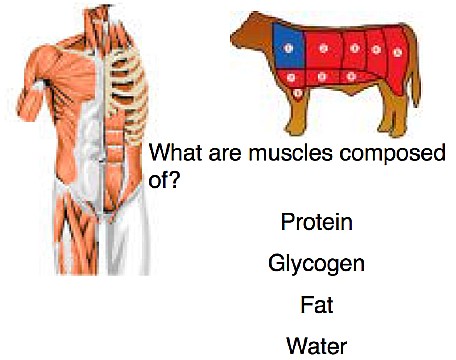
What do insulin & glucagon have in common? How are insulin & glucagon different? If you're not sure, post a question in the forum. If you have already used up your liver's glycogen, the next way your body has of getting glucose is rearrange the protein in muscles into glucose. Which of the components
of muscles are surprising to you?
So when your blood sugar falls & liver glycogen is gone, protein in muscles can be used to raise your blood sugar. Now you should be able
to list the 3 ways your body can raise your blood
sugar.
1. Eat 2. Breakdown liver glycogen 3. Rearrange protein into glucose Notice there is no mention about fat above. If you were in a situation where you would need to rearrange protein into glucose (starvation or a very low calorie diet) you would be using fat as a fuel, you would just NOT be using significant amounts to make glucose for the brain.
|
| When your cells are
deficient in glucose, it causes a buildup of
ketones in blood, something that is called ketosis.
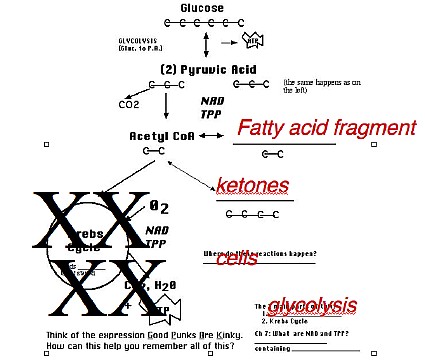
Look again at the Cellular Respiration illustration that is in your lecture outline and use the image below to fill in another blank. The Krebs Cycle is the aerobic part of Cellular Respiration, meaning that part requires oxygen. Can you see that oxygen is added to the Krebs Cycle, but not to Glycolysis? And can you see that the Krebs Cycle needs glucose to get started? When fat is used for energy, the 2-carbon fatty acid fragments go though the Krebs Cycle. But if glucose is not in the cells, the Krebs Cycle can't happen and the 2-carbon fatty acid fragments combine to make 4-carbon ketones, shown below: One situation that can lead to less glucose being in cells and therefore ketosis is starvation. Another is uncontrolled diabetes because there is not enough insulin to help glucose enter cells or cells do not respond to the insulin. You have also probably heard of people going into ketosis by eating a high protein, low-carbohydrate diet (< 50 grams per day). Symptoms of ketosis include decreased appetite as well as increased thirst & urination. Ketones are excreted from the body by several routes, including the mouth and the urine. Since they leave a disagreeable taste in your mouth, ketones can decrease appetite. In order for the kidneys to work effectively, they like substances that come their way (be they salts or sugars or ketones) to be dissolved in plenty of water. So the kidneys signal you to drink more. And later you urinate more. Short-term ketosis itself might not be dangerous, except if a person has diabetes or is pregnant. But if your body is in ketosis, what does this also mean is happening in the body? (Hint- If you're in
ketosis, it means your cells aren't getting enough
glucose. So how will your body make sure your
brain gets some glucose?)
|
| Symptoms of hypoglycemia include
weakness,
headache and confusion. Some people with
hypoglycemia have symptoms but normal blood
sugar. Hypoglycemia may
be caused by frequently changing from a low
carbohydrate diet to a diet with lots of sugar. When a person rapidly eats lots of sugar, the pancreas gets a VERY URGENT message to secrete insulin. Lots of insulin is secreted and blood sugar plunges. The cause of true hypoglycemia may be a tumor of pancreas or hepatitis of the liver or other disorder. The DIAGNOSIS of Hypoglycemia (& diabetes) is the Glucose Tolerance Test. To find out more, watch the short Video Clip below. |
|
approximately 4 minutes Glucose Tolerance Test video |
E. Diabetes. There
are two types of diabetes, Type 1 and Type 2.
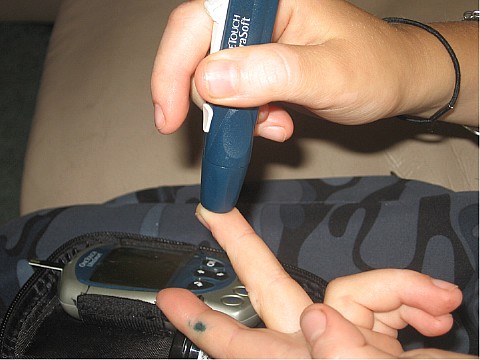
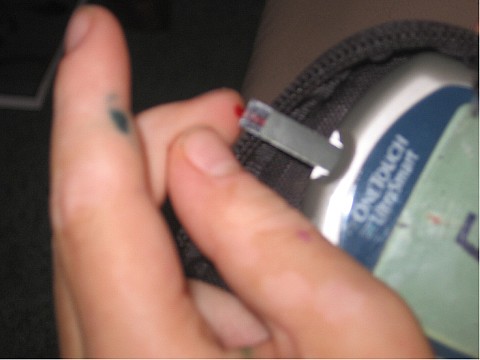
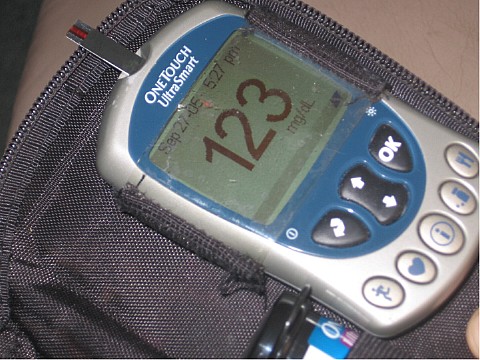
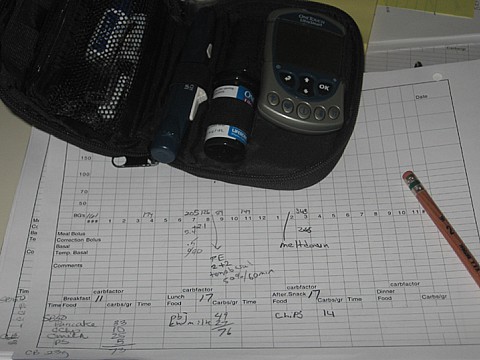
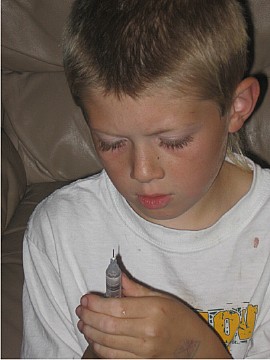
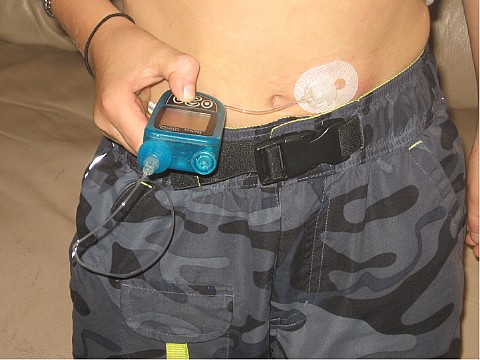
People with Type 1 diabetes don't make enough insulin, so they must take it by injection. Insulin cannot be taken in pill form because it's composed of proteins which would be enzymatically digested by the digestive system. Problems for people with Type 1 and Type 2 diabetes come from long term high blood sugar (hyperglycemia) and low cell glucose. Capillaries are destroyed so tissues die because there aren't enough capillaries to deliver oxygen. This sometimes causes kidney & eye disease, nerve damage, and heart attacks. Guy, the son of an LCC chemistry faculty, was diagnosed with Type 1 diabetes while still in elementary school. He quickly learned skills at managing his disease, including pricking his finger to check and chart blood sugar levels. |
| People with Type 2 diabetes make enough
insulin, but their cells are resistant to the
insulin. They are sometimes given a pill that
stimulates the pancreas to make even more insulin, but
that pill is not actually insulin. Type 2 diabetes is an advancement of the insulin resistance seen in pre-diabetes. To read more about insulin resistance and type 2 diabetes check out the following website: National Diabetes Information Clearinghouse (NDIC)If you're interested below is a video that describes the causes and complications of type 2 diabetes a bit more. The treatment for Type 2 diabetes has 4 parts:
Is this different
than recommendations for people without diabetes?
Rates of diabetes are exploding world-wide because all over the world, obesity is a problem. Body fatness is strongly associated with the development of diabetes. Diabetes is surging worldwide, By Marc Santora, June 18, 2006, International Herald Tribune. Here's part of what this article says: "There are many
factors driving the growth in diabetes worldwide, but
most experts agree that changes in lifestyle and diet
are the chief culprits, in addition to genetic
predisposition. As developing countries rapidly
industrialize, people tend to do work involving less
physical activity. At the same time, the availability
of food that is cheap but high in calories becomes
more common.
"The combination causes weight gain, which leads to greater risk of developing Type 2 diabetes, the most common form of the disease. The other form, Type 1, is responsible for 5 percent to 10 percent of cases and is not associated with behavior but is believed to stem almost entirely from genetic factors." END of L4B
|