Does it represent glycolysis, or does it represent the Krebs cycle?
Click here if you think it represents glycolysis.
Click here if you
think it represents the Krebs cycle.
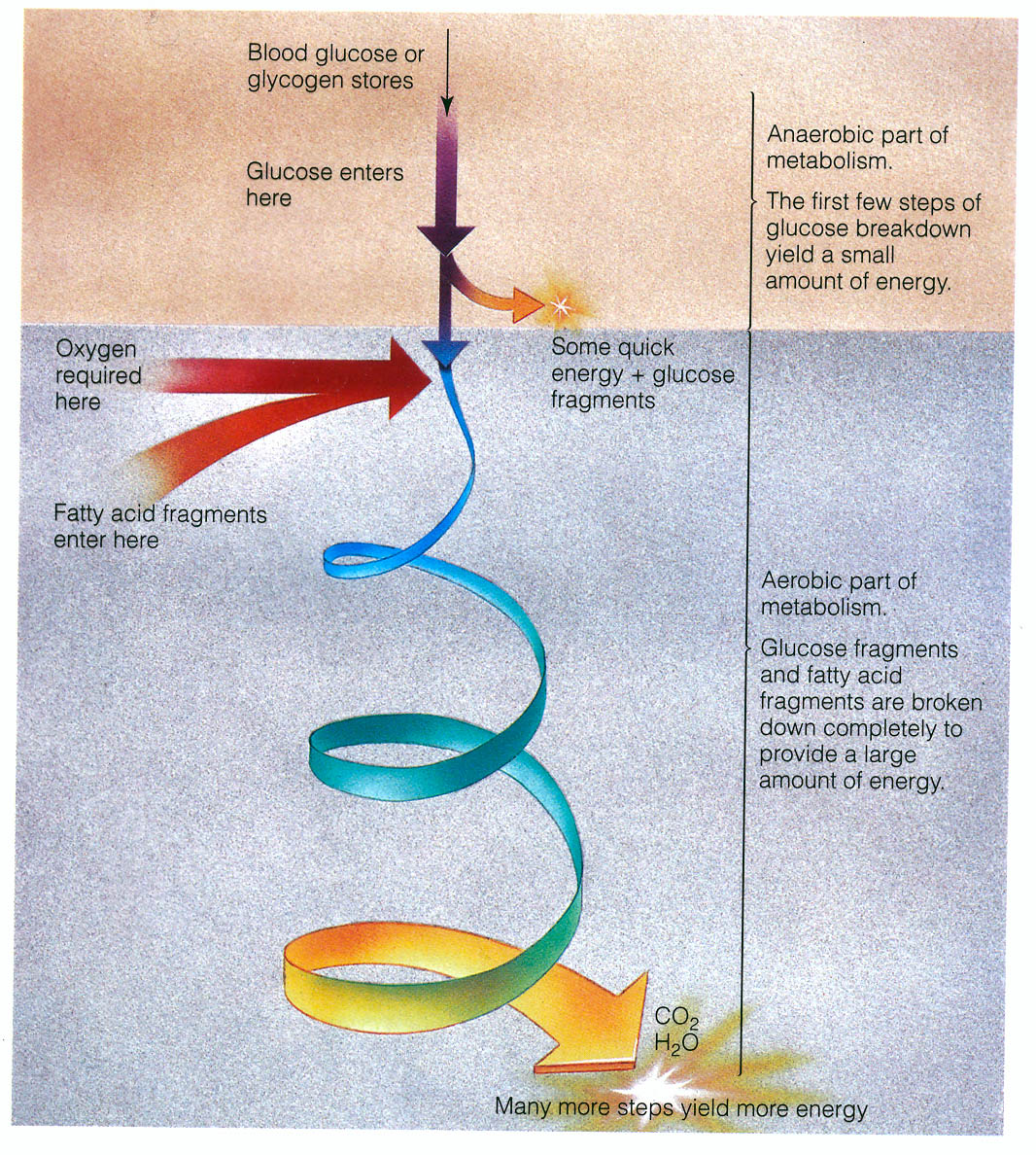
What does the blue to green to yellow spiraled arrow represent?
Click here if you think it represents glycolysis.
Click here if you think it represents the Krebs cycle.
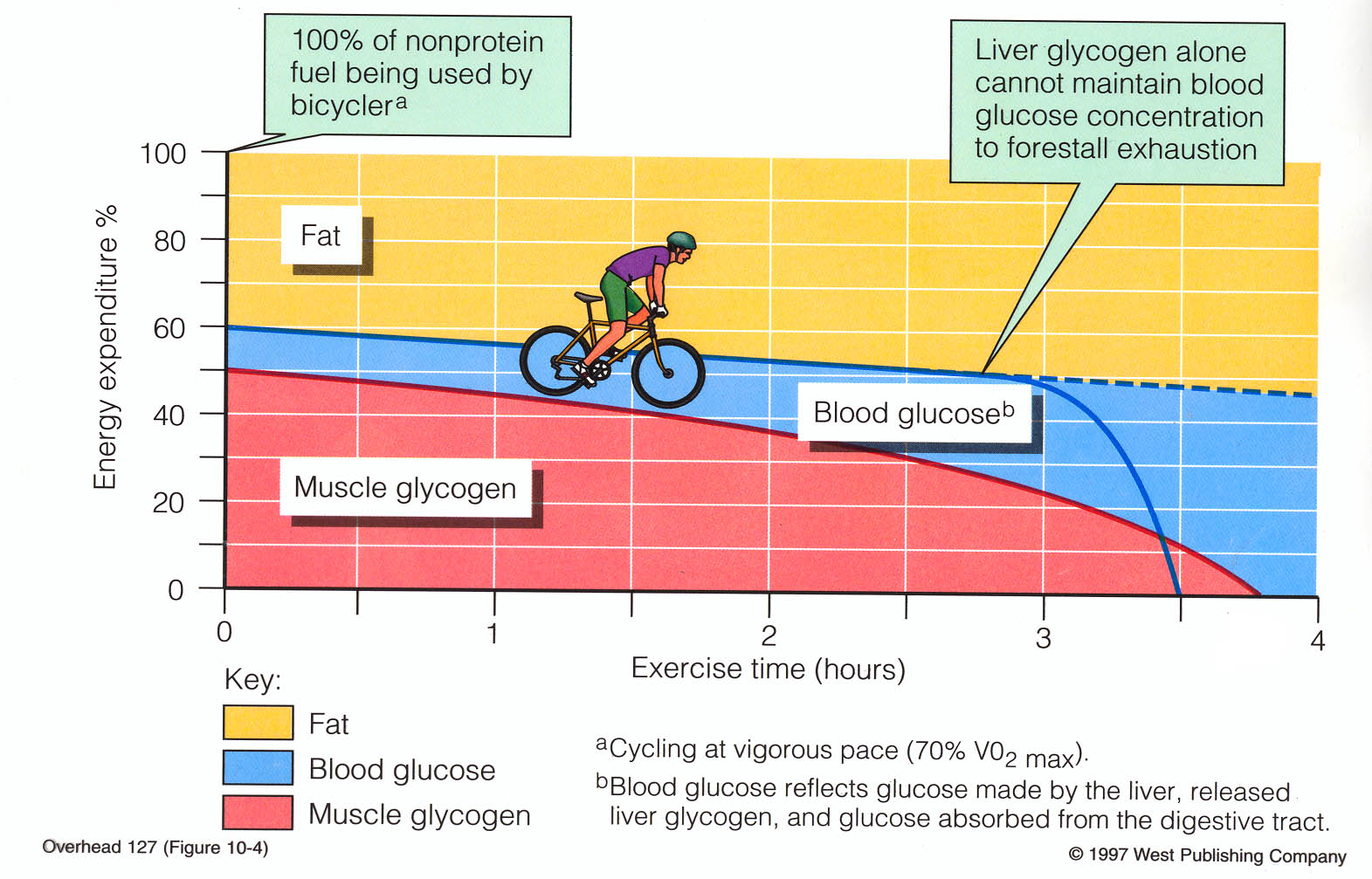
The image below shows that fat and glucose (blood glucose and muscle glycogen) are the primary fuels used during aerobic activities like walking, cycling, and jogging.
You can click on the image if you want to see a larger version.
As time goes on, the rider is using more ________ than glycogen.
When does glycogen run out for this bike rider?
One of the advantages of relying on fat for an energy source is that it is abundant, even in lean people. For example, a man who weights 154 lbs who has a body fat level of 10% has approximately 15 lb of body fat, which is equivalent to more than 50,000 Kcal of energy! This is significantly more energy than can be provided by his stored muscle glycogen (800-2,000 kcal)*
* Information taken from Thompson, M
& Manore, M & Vaughan L. (2011). The
Science of Nutrition.
Two ways you can manipulate what you do to make glycogen last as long as possible is to:
- Train so you build up the number of
fat-burning enzymes you make. That means
you can burn more fat for energy, conserving
glycogen for as long as possible. More
highly trained individuals also make more and
larger mitochondria. The mitochondria is
the powerhouse of the cell where aerobic
metabolism takes place.
- Eat plenty of whole foods with carbohydrate
so you have glucose to make glycogen.
Activities like fast running that are high in
intensity and short in duration (30 seconds to 3
minutes) need an energy source that can be used
quickly to provide ATP. The breakdown of
carbohydrates (muscle glycogen as well as blood
glucose) provides this quick energy through
glycolysis.
Fat is not a fuel that is used during anaerobic activities because fat is relatively slow to breakdown, and it requires oxygen.
During glycolysis, the six-carbon glucose is
converted to two molecules of three-carbon pyruvate.
When oxygen is present pyruvate can continue through
Aerobic metabolism, or the Krebs cycle. When
oxygen is not present (like in the case of sprinting),
pyruvate gets converted into lactic acid. Click
here to see an animation on the glycolysis
process.
Summary of Fuels Used for Activities of Different Intensities and Durations
|
Activity Intensity |
Activity Duration |
Preferred Fuel |
Oxygen Needed? |
Activity Example |
| Maximal |
3-15
sec. |
ATP-CP |
No |
Sprint
start |
|
Very High |
15 sec. – 3 min. |
Glucose |
No |
Running (fast) |
|
High to moderate |
3 min. – 4 hours |
Glucose |
Yes |
Running, jogging |
|
Moderate to low |
> 4 hours |
Fat |
Yes |
Walking |
Protein is not a major fuel source, but is used to build and repair muscles. The protein needs of different athletes are listed in the table below.
RECOMMENDED PROTEIN INTAKES FOR ATHLETES
| Type of
Individual |
Recommendations
(g/kg/day) |
Protein Needs for a 70 kg male (g/day) |
Protein needs for a 55 kg female (g/day) |
| Endurance Athlete, adult |
1.2-1.5 |
84-105 |
66-83 |
| Strength athlete, adult |
1.3-1.8 |
91-126 |
72-99 |
If you are an athlete, the extra protein you need is mainly needed to build and maintain muscle and other lean tissue. If you want to gain 1 pound of muscle per week, you only need 14 grams of extra protein per day, the amount in 2 ounces of meat (Bernardot 1992). Exercise, not extra protein, is the key to developing bigger muscles. Any excess protein that you take in beyond the above recommendations is burned for energy or, stored as glycogen or fat (depending on Calorie intake). Humans do not store excess protein as muscle, protein, or amino acids.
COMMON QUESTIONS REGARDING PROTEIN*
1. What’s the concern of too much protein? You’ll crowd out carbohydrates which fuel your muscles. When athletes focus too much on protein, and not enough on carbohydrates they often sacrifice endurance.
2. Do I need to eat as soon as I finish exercising? There is a 45 min. post exercise window to nourish, repair, and build muscles. You can switch out of the muscle breakdown mode by eating a combination of carbohydrate and protein as soon as tolerable after you exercise. Good examples of this are a yogurt and fruit, or a peanut butter sandwich.
3. Do I need to eat protein every 3 to 4 hours to support muscle growth? Yes, when amino acid levels are above normal, the muscles take up more, enhancing muscle growth.
4. Are protein supplements better than real food? Protein supplements are a mindless way to get protein, and are often quick and convenient, but they don't offer any benefit over whole foods. The advantage of getting protein from whole foods is that protein comes packaged the way nature intended, and whole foods also contain phytochemicals and other yet-unknown bioactive compounds that might influence muscle growth. Whole foods are also typically less expensive than protein supplements.
*The above information was taken from Nancy Clark's
Sports Nutrition Guidebook, 2008.
Your lecture outline has a chart comparing
Heat EXHAUSTION and
Heat STROKE
Heat STROKE is more dangerous because the high temperature can denature body proteins, which can lead to loss of brain function and death.
What sports drinks offer besides fluid, to those exercising over one hour:
- Electrolytes like sodium- may accelerate glucose & water absorption from digestive tract. About 225 mg per 12 oz. (150 mg per cup) is enough.
- Glucose: no more than 7%, which is about 23 grams per 12 oz. (15 grams per 1 cup). More sugar than that delays fluid going from the stomach to the small intestine where it can be absorbed.
- Psychological edge
- Taste
Homemade sports drink: 1 qt. water, 1 cup sugar-sweetened fruit juice, 1/3 tsp. salt