FN
255: Introduction to MNT
Teresa (Snyder) McFerran, MS, RD
Health Professions Division
Lane Community College
Eugene, Oregon
Unit 1 Preparations, Chapter 1
Nutrition and Health: Overview
Unit 1 Orientation
Quiz DUE before midnight (11:55 pm) SUNDAY, April
7th
Unit 1 Study
Questions DUE before midnight (11:55 pm) SUNDAY, April 7th
Refer
to
pages 2-16 of your
packet for a hard copy of the information below.
You do NOT need to
print this document, if you have the packet for FN 255.
WELCOME to FN 255! Although
this is a fully on-line class, and we will not be meeting
face-to-face during the term, I want you to know that my goal is
to guide you through this course as if I were sitting right next
to you. If questions or concerns come up please take a deep breath
and re-read the material, and maybe skim the Syllabus, before
allowing yourself to become flustered. Once you have taken a deep
breath and re-read the material please consider re-starting your
computer (if this applies) or taking a short five-minute break. If
you are still confused feel free to contact me through our Moodle
messaging system or post your question(s) in our weekly forum. I
would highly encourage you not to wait until the last minute to
submit assignments so you have ample time to resolve any possible
road bumps that may arise. Best wishes and I look forward to
getting to know you as the term unfolds!
ACTIVITIES AT A GLANCE. Check them off as you complete
them.

|
Before midnight (11:55
pm) SUNDAY, April 7th, fill out the Unit Preparation Questions
listed below, then complete the Orientation Quiz for 5 points. (If you
have any questions, post them in our "Forum Week 1" in Moodle.)
|
|
Sometime AFTER you've
completed the Orientation Quiz, briefly introduce yourself
in our "Forum Week
1". (Refer to the instructions below.) |
|
By midnight (11:55 pm)
SUNDAY, April 7th,
complete Unit 1 Study
Questions for 10 points (be certain you've FIRST
done ALL of the Unit Preparation Questions below). (If you
have any questions, post them in our "Forum Week 1" in Moodle.)
|
OBJECTIVES
After reading the assigned reading, filling out the Unit
Preparations below, participating in the "Forum Week 1", and completing the
Orientation Quiz AND
Unit 1 Study Questions,
you will be able to:
- Know how this course is organized and where to find the
activities and assignments for each week.
- Communicate with other students in this class and gain
confidence to in our online learning environment.
- Discover due dates for activities in this class, plan
your time commitment accordingly, and set yourself up for
success in this class.
- Define the term "medical nutrition therapy" and
understand some of the common settings where MNT takes place.
- Understand the impact of cultural influences on nutrition
and the importance of cultural competency.
- Review some of the basic principles of nutrition in order
to be able to set MNT goals for a variety of health conditions
throughout the term.
RESOURCES
- Unit 1
Preparations (this document)
- Mosby's Pocket Guide
Series Nutrition Assessment and Care, Ch 1: Nutrition & Health
pp. 3-40
- Reading Calendar (above Week 1 in Moodle)
- Syllabus (above Week 1 in Moodle)
- Merriam webster medical dictionary: http://www.merriam-webster.com/
(select "medical")
- Please use the online medical dictionary to look up any
terminology you may not understand as you are reading the
text.
WEEKLY FORUMS:
Each week, there will be a FORUM that will allow you to post any questions you have about the
lecture or materials covered as well as allow the instructor to
post any changes or corrections
that need to be communicated.
A study question will ask if you participated at least once in this week's
forum BEFORE Friday at 5pm. (Refer the syllabus for additional
details and note that starting next week two forum postings
are required each week.)
FORUM WEEK 1: (Go to our
Moodle classroom and click on "Forum Week 1" to participate.)
- "Introductions": Briefly introduce yourself by
telling us were you grew up, what subject you are studying,
and briefly explain anything about your life right now you'd
like to share, such as your major/career goals,
hobbies/interests, etc. Make sure to include how long it has
been since taking either FN 225 or 105 and what prompted you
to enroll for this course.
-
"Student Questions": Do you have any questions
about the Unit 1
Preparations? Please post your questions/concerns in the
forum for others to be able to respond.
- "Online Success": Since this is an online class,
without a defined time for lecture, it may be a challenge to
find time during your busy week to complete the Unit
Preparations, Case Studies, and SQ (Study Questions). How will
you find a routine time, if you think that's important? If
you've taken an online class before, what wisdom can you
share? If this is your first online class what are your
fears/concerns and how have you already started overcoming
them?
-
"Cultural Competency": Based on the list of ways
in which you can seek out opportunities to develop
culturally competent skills in the Unit Preparations this
week, what ideas seems most practical for you to develop at
this time?
- "Health": How do you personally define the word
"health" or "healthy"? The Word Health Organization (WHO)
defines health as a "state of complete mental, physical, and
social well-being, not merely the absence of disease or
infirmity". How is this definition similar and different than
your definition for health?
-
CORRECTIONS / CLARIFICATIONS: (Please check our weekly
forum for additional corrections and clarifications.)
Notice what your syllabus says in the "Editing Profile" section
for disabling your email
address if you would rather not get messages in
your personal email regarding this class.
Orientation Quiz Questions
(due BEFORE midnight (11:55 pm) SUNDAY, April 7th)
BEFORE you begin the
Orientation Quiz in Moodle, complete
the answers to each of the following Orientation Quiz Preparation
Questions in your packet.
NOTE: During the first week there is an orientation quiz. The goal
is for you to feel more comfortable in this online environment and
understand the goals and objectives of this course. You can take
this Quiz two times and your final score
will be the highest of
the 2 scores. (Unit Preparations for Unit 1 SQ follow this.)
1. Go to our Moodle class and click on FORUM Week
1. Are there any CHANGES or CORRECTIONS or CLARIFICATIONS posted there? _____________
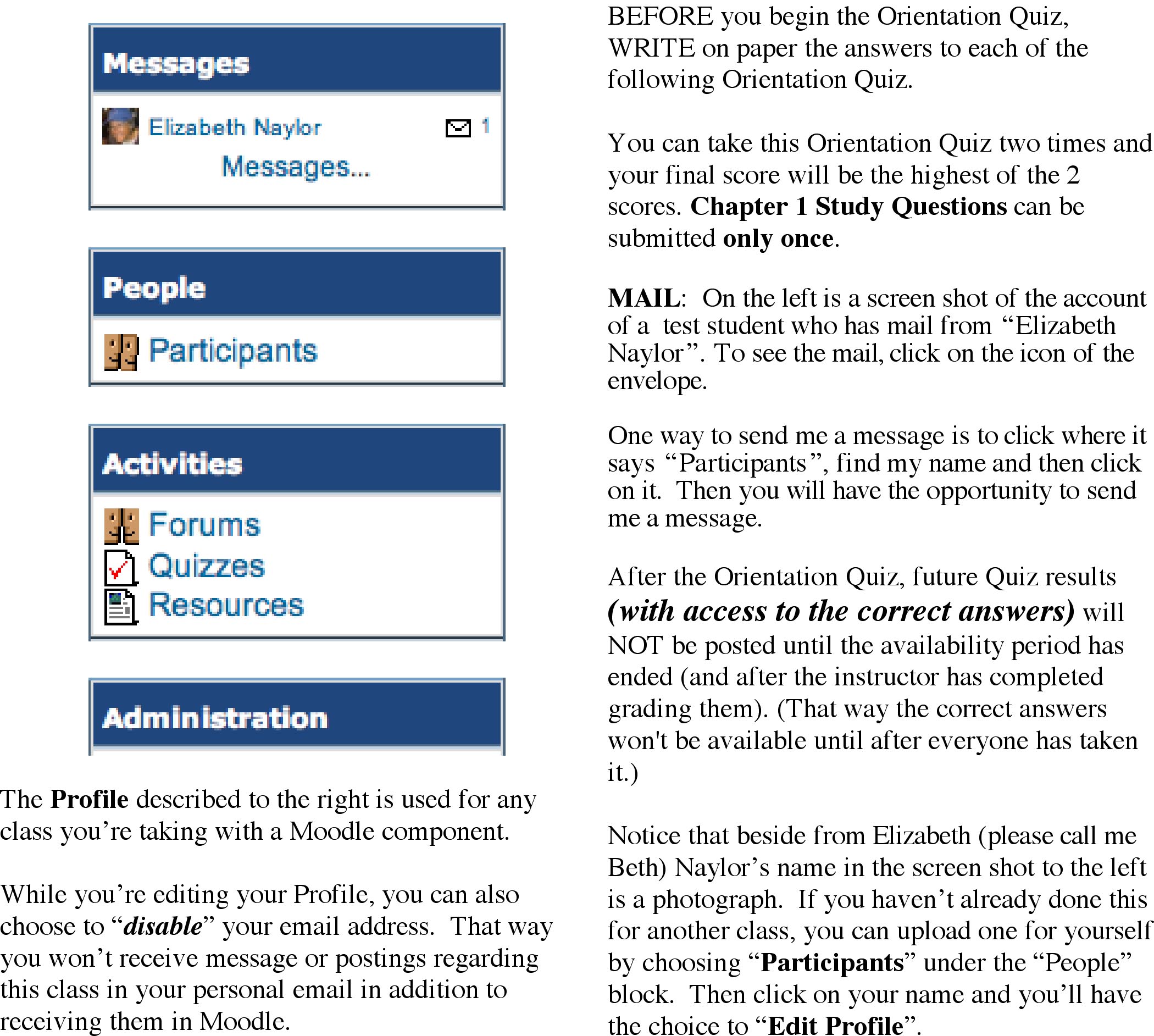
Use the following "screen shot"
to help answer questions 2-8:
2. According to the information beside the
screen shot above, should you write down answers to these questions
before going online to take this
Orientation Quiz (as well as all future Study Questions, which are
in the packet)?
A. Yes. I should
write down my answers to these questions before going online.
B. No. I do
not need to write down my answers to these questions before going
online.
3. According to the information beside the screen
shot just above, how many times can you take this Orientation Quiz?
A. one time
B. two times
C. three times
D. unlimited times
4. According to the information beside the screen
shot you’ve been looking at, how many times can you submit the Unit 1 Study
Questions? (The verbiage above
states "Chapter 1" Study Questions, instead of "Unit 1".)
A. one time
B. two times
C. three times
D. unlimited times
5. According to the information beside the screen
shot you’ve been looking at, where is the envelope icon saying you
have mail?
A. It is below the
word "People".
B. It is below the word "Mail".
C. It is below the word "Administration".
D. It is below the word "Messages".
6. According to the information beside the screen
shot you’ve been looking at, what do you click on to see that mail?
A. You click on
the envelope icon.
B. You click on the number 1.
C. You click on the word "People".
D. The information beside the screen shot says
that any of the above would work.
E. The information beside the screen shot says
that none of the above would work.
7. According to the information beside the screen
shot you’ve been looking at, it says "One way to send me a message
is to click where it
says 'Participants', find my name
and then click on ____________. "
A. my name
B. the word "Messages"
C. the word "Mail"
8. According to the information beside the screen
shot you’ve been looking at, when will future Study Question results
(with access to the
correct answers) be posted?
A. first thing
Monday morning
B. after the availability period has ended
C. first thing Tuesday morning
9. Previously the Unit Preparations talked about
disabling your email address if you would rather not get messages in
your personal email regarding
this class. It
says you do that while you are editing your ___________________.
10. According to the Note near the beginning of
the Syllabus, what happens if you do NOT complete the Orientation
Quiz and Unit 1
Study Questions by
midnight SUNDAY of Week 1?
A. You may be
administratively dropped from the class.
B. You receive a deduction of 25% of the total
possible points.
C. You receive a deduction of 50% of the total
possible points.
11. According to the information in the Syllabus,
which is the best way to reach me?
A. by leaving a
Voice Mail message on my LCC telephone
B. using my LCC email address
C. using the mail system in our Moodle ”class”
12. According to the information on the first page
of the Syllabus, which prerequisite(s) is/are required BEFORE you
can take this course?
A. FN 225 and FN
105
B. FN 225 or FN 105
C. There are no perquisites required to take
this course.
13. Which of the COURSE OBJECTIVES are you most
interested in learning about?
14. The LCC library has computers you can use. There is
also a computer lab in Building 4 (the Health Building).
According to the
Syllabus, what is the
room number of that lab?
15. According to the “TIME COMMITMENT” section of the
Syllabus, you will probably have the most success with this class if
you log
on at least how many
times per week?
A. One time per
week
B. Two times per week
C. Three times per week
D. Four times per week
16. According to the “SUGGESTIONS FOR SUCCESS IN THIS
CLASS” section of the Syllabus, which of these do you think will be
most helpful for you to know
to be successful in the class?
17. According to the "STUDY QUESTIONS and LATE HOMEWORK"
section of the Syllabus, with a deduction of points, until when
can Study Questions be
submitted late online?
A. Monday at
midnight (11:55 pm)
B. Tuesday at midnight (11:55 pm)
C. Wednesday at midnight (11:55 pm)
18. According to the "Late Homework" section of
the Syllabus, if Study Questions are no longer available online,
what
should a student do?
A. Paste them into
a Moodle mail message to the instructor.
B. Send them as an attachment in Moodle mail.
C. Send the instructor a message and she will
re-open them for you.
19. According to the “POLICY ABOUT RETURNING
EXAMS” section of the Syllabus, why are students not able to see
graded
exams? (Note: The
instructor typically posts graded exams for students to review for
~48 hours once they've been graded.)
A. To prevent
exams from being in circulation
B. To prevent decreasing their reliability as an
assessment tool
C. To mirror the policy for in-class sections of
nutrition classes at LCC
D. All of the above
20. According to the “GRADED ASSIGNMENTS” listing
at the end of the Syllabus, during what week is Exam 1?
A. Week 4 (DUE Tuesday)
B. Week 5 (DUE Tuesday)
C. Week 6 (DUE Tuesday)
21. According to the “GRADED ASSIGNMENTS” listing
at the end of the Syllabus, when are the Study Questions for Week 1
due?
A. Saturday of
week 1 before midnight (11:55pm)
B. Sunday of week 1 before midnight (11:55 pm)
C. Monday of week 2 before midnight (11:55 pm)
D. Tuesday of week 2 before midnight (11:55 pm)
22. There are "availability dates" on Moodle for
all of the Study Questions and Exams. Sometimes I
unintentionally make
mistakes when I set
those dates. If you notice a mistake (like if I set it to open
on February 1, 2005 instead of 2010), please let me
know as soon as you
notice it so I can correct it. Also please let me know of any
typos of mine you catch so I can correct them.
A. I understand
this.
B. I don't understand this, but I will send the
instructor a message.
23. Most of the Study Questions are set to be
scored by the computer. If you are marked as incorrect for a
question because of a typo or an
understandable
misspelling (like you spelled it cholestrol when it's cholesterol),
please let me know and I will consider adjusting your
score.
A. I understand
this.
B. I don't understand this, but I will send the
instructor a message.
24. Based on the information regarding the Unit 1
Preparations in italics
below, what is the best way to prepare for the weekly Unit SQ?
25. When you submit your answers in Moodle, the
last question will ask if you took the quiz on time.
(Note: If you take a quiz after the due
date, please send me a message. It will probably not be graded
until you do that
as I may not realize it was done. I can do this ONE time.)
Unit 1 Preparations, Chapter 1
Nutrition and Health: Overview
Refer to pages 6-16 of
your packet for a hard copy of the information below. You do NOT need to print this
document, if you have the packet for FN 255. Unlike
the Orientation Quiz questions above, the Unit Study Questions
will be based on the answers you obtain from filling in ALL of
the blanks and checking out the links for the Unit 1
Preparations below. In other words, you will not receive a
copy of the actual SQ (study questions). Filling out the unit
preparations is the best way to prepare for the SQ, and
considering all quizzes are timed, you will not have ample
time to complete the quiz if the Unit Preparations are not
completed first.
The following topics will be covered this week:
I. Medical
Nutrition Therapy Defined
II.
Cultural Influences on Nutrition and Cultural Competency
III. Nutrition Review
IV. Chapter 1: Nutrition & Health Overview
I.
Medical Nutrition Therapy Defined
Considering the title of this class is Introduction to Medical
Nutrition Therapy, it's important that you can define the term
medical nutrition therapy. The following are a few definitions:
-
Page 281 of our Mosby text states that "acute and
chronic illnesses are treated in a variety of settings,
including acute care hospitals, rehabilitation centers,
extended care facilities, clinics, offices of private
practitioners, and patient's homes. Whatever the setting,
however, nutrition care is an essential part of treatment.
In recognition of its importance, assessment, planning, and
nutrition care of medical, surgical, and emotional
conditions are referred to as medical nutrition therapy."
- Based on the Mosby definition of MNT above, list the common
settings where MNT takes place:
-
A textbook commonly used by nutrition majors when
studying MNT defines medical nutrition therapy as "the use
of specific nutrition interventions to treat an illness,
injury, or condition" (Krause's food, nutrition and diet
therapy, 11th edn, L.K. Mahan, S. Escott-Stump, p. 496).
-
The Academy
of Nutrition and Dietetics, or AND, defines MNT as
“nutritional diagnostic, therapy, and counseling services
for the purpose of disease management which are furnished by
a registered dietitian or nutrition professional...” (source
Medicare MNT legislation, 2000). MNT is a specific
application of the Nutrition Care Process in clinical
settings that is focused on the management of diseases. MNT
involves in-depth individualized nutrition assessment and a
duration and frequency of care using the Nutrition Care
Process to manage disease.
-
The Centers
for Medicare and Medicaid Services, or CMS, recognizes
that "nutrition and diet play an important role in helping
people with certain diseases manage their health. For people
with diabetes or renal diseases, proper
diet and nutrition can help prevent and reduce complications
from their conditions. Medicare covers medical nutrition
therapy services for people with diabetes or renal diseases
to help them manage their conditions."
- Which two nutrition-related diseases does Medicare
cover MNT services to help manage?
Based on the definitions you've just read, try paraphrasing MNT
into your own words.
Considering CMS provides coverage for MNT for people with certain
diseases, it seems pertinent to recap the ten leading causes of
death in the U.S. (causes in bold indicate that the cause of death
is related to nutrition):
* Heart
disease
* Cancers
* Strokes
* Chronic lung disease
* Accidents
* Diabetes
mellitus
* Pneumonia and influenza
* Alzheimer's disease
* Kidney disease
* Blood infections
II. Cultural
Influences on Nutrition and Cultural Competency
Recently the instructor completed a course entitled "Cultural
Competency: Values, Traditions and Effective Practice". The
speaker was a Registered Dietitian who acknowledged that it is
often our lack of knowledge
about unusual or authentic foods that makes providing effective
nutrition education and counseling difficult. However, to
understand authentic cultural foods, one must understand the
culture behind it. A large portion of the information in the link
included below is from the workshop attended and permission has
been granted to use the material. However, it is also realized
that cultural competency cannot
be taught in a seminar or PowerPoint presentation. The goal of
covering this material is to foster an intellectual journey.
Use the information below to fill in the
blanks for the Unit 1 Preparations section
II
Cultural Influences on Nutrition and Cultural Competency.
Some of the commonly cited reasons for needing culturally
competent health care individuals includes the following:
- demographic diversity and projected population shifts
- increased utilization of traditional therapies
- disparities in health status of various racial/ethnic
groups
- under representation of health care providers from
diverse backgrounds
Merriam-Webster Dictionary defines culture as "... the integrated pattern of human
knowledge, belief, and behavior that depends upon man's capacity
for learning and transmitting knowledge to succeeding
generations." Therefore, culture is not something we are born
with, but rather it is learned and passed on from one generation
to the next. Culture encompasses more than simply race or
ethnicity because it is a shared system of values, beliefs,
attitudes, and learned behaviors. For example, dress, family
structure, language, and food habits often indicate one's culture.
Below are a few pictures that were taken while my husband lived in
Japan. The first picture shows the traditional attire that is worn
for kyudo, or Japanese archery. The second picture was taken at
the end of a tea ceremony, or chakai, and the women are all adored
in kimonos. The next picture is of me taking shodo or calligraphy
lessons in Japan, and the last picture is of dango, which are
Japanese dumpling made from rice flour and is often served with
green tea.


Every decade a census of the United States is conducted. According
to the U.S. Census 2000, 284 million people live in the United
States. The categories used in the most recent census included
white, black or African American, American Indian and Alaska
Native, Asian, Native Hawaiian and other Pacific Islander, and
"some other 'race.'" Note: Clearly, there are many subgroups
within each of these categories.
The expected changes in the nation's demographic makeup in race
and age categories have been cited numerous times as reason enough
for health professionals to pursue personal competence in cultural
knowledge. It is projected that by 2050 Latinos will triple to become the largest
minority group and the percentage of Asians will nearly double. By 2065 Non-Hispanic
whites will most likely be a minority
group.
The U.S. Census Bureau website, 2005-2007 American Community
Survey includes a breakdown of the demographic characteristics of
Lane County, Oregon:
POPULATION OF Lane County: From 2005-2007, Lane County had a total
population of 340,000 - 172,000 (51 percent) females and 167,000
(49 percent) males. The median age was 38.1 years. Twenty-one
percent of the population was under 18 years and 14 percent was 65
years and older.
Please go to the following link (http://factfinder.census.gov/)
and enter Lane County, Oregon. Then scroll down to the bottom of
that page for the demographics. Based on the information, answer
each of the following questions:
- What percentage of the population in Lane County, OR
considers themselves to be "white"?
- How does the percentage of the population that is "white"
in Lane County, OR compare to the overall U.S. population?
- What three racial groups (do not include the categories
"some other race" or "two or more races") comprise more than
1.1% of the population in Lane County?
- Based on the racial breakdown of Lane County in
comparison to the overall U.S. population, do you think Lane
County is more or less racially diverse than most areas of the
US?
Using the maps below, what do you find to be most surprising or
interesting? (Map 1 shows the percent of
the total population who are American Indian and Alaska Native
alone in 2007 and Map 2
shows the percentage of the total population who are Asian alone
in 2007.) If you cannot view these maps here, please
view them separately in Moodle week 1 (they can be found under
the Unit 1 Preparations link.)
Map 1: Percentage of the
total U.S. population who are American Indian and Alaska Native
Map 2: Percentage
of
the total U.S. population who are Asian alone

Many agree that the US population is currently more like a "salad bowl" rather than a
"melting pot." A salad may contain many ingredients, and blend
into a harmonious whole, but each ingredient retains its unique
taste and texture.
However, it is not enough to simply recognize and accept that our
culture continues to diversify. Cultural
competency, especially in healthcare, is the ability to
understand and respond effectively to the cultural and linguistic
needs of patients or clients. Implied is the acceptance and
tolerance of different backgrounds and their associated traits,
beliefs, etc., and absence of prejudice against unfamiliar
cultures. Learning to value diversity and being open-minded about
other cultures are key characteristics of cultural competency. A
culturally competent professional recognizes and understands the
differences in his or her culture and the culture of the patient
or client. Therefore, it is no wonder that cultural competency is
a current buzzword in health care.
Cultural competency is a process
that occurs along a continuum. At one end of the continuum is
cultural destructiveness and at the other end is cultural
proficiency. The chart below was developed by the National Center
for Cultural Competence in 1999. (If you cannot view the
continuum here, please view it in Moodle in week 1 under Unit
1 Preparations.)

According to the University of Michigan Health System, the steps
involved in developing personal cultural competency are as
follows:
- Recognize your own personal cultural biases and
preconceived ideas/opinions;
- Desire to learn about and become involved with people
from diverse cultures;
- Seek out and increase your knowledge about other
cultures; and
- Learn and develop multicultural communication and
counseling skills.
Considering self-assessment is an essential element of cultural
competence, the following activity
will allow you to assess your cultural competence:
Cultural
Competence
Health Practitioner Assessment
- Click on the link above to participate in The Cultural
Competence Health Practitioner Assessment.
- Next click on "Begin the Cultural Competence Health
Practitioner Assessment (CCHPA)" at the bottom of the page to
start the assessment.
- Based your results for the clinical decision-making subscale, which one
recommendation does your profile indicate that you could
benefit from gaining knowledge that you think would be most
practical (e.g. explore the range of holistic traditional
practices used by communities served).
- Which one
of the resources for the cross-cultural communication subscale
sounds most interesting (e.g. Communicating Effectively
Through an Interpreter (1998) (Available from the Cross
Cultural Health Care Program, 270 South Hanford Street, Suite
100, Seattle, Washington 98134; Phone (206)-860-0329; Website
www.xculture.org).
Along this journey to attain cultural proficiency, it is
important to understand the difference between stereotyping and
generalizations. Stereotyping
is an assumption that ALL people in a particular group think and
behave alike. Stereotypes are often judgmental and do not allow
for individual differences--for this reason, a stereotype is an ending point. For example, a
stereotype could be that "All white southerners eat pork, have
buttered grits for breakfast, and drink sugared tea." In contrast,
generalizations refer to
the trends or behaviors within a group, but with the knowledge
that further information is needed to determine if the
generalization applies to this particular person. Therefore,
a generalization is a starting
point. An example of a generalization-based questions is asking a
Jewish client "Do you follow traditional Jewish dietary laws?"
This question provides a starting point to work from rather than
stereotyping that all Jewish clients follow traditional dietary
laws.
Keep in mind that just as individuals within a cultural group are
unique, so are their diets. For example, not all
Japanese-Americans like wasabi. Thus the emphasis should be on
seeing the patient or client as an individual, which is also known as
patient-centered care. Providing patient-centered care can prevent
bias, prejudice, and stereotyping on the part of healthcare
providers from contributing to differences or disparities in care.
After all, the connection with the patient or client is the most important component.
According to the National Center for Cultural Competence, cultural
competency in healthcare is paramount for fostering more favorable
clinical outcomes, results in positive and rewarding interpersonal
experiences, and promotes patient or client satisfaction. In order
for health care to be successful, services must be received and
accepted. The real benefit of cultural competency is improved
outcomes. Cultural competency is NOT an optional skill to learn,
but rather a necessity.
In order to deliver culturally competent care, health care
providers should understand: beliefs, values, traditions and
practices of a person's culture, family structure and the roles
within the family in making decisions, health-related needs of
individuals, families, and communities, cultural beliefs about
health and etiology of diseases, cultural beliefs about healing
and disease treatments, and attitudes about seeking help from
health care providers.
The dominant American cultural paradigm is largely derived from
Anglo-American heritage and places high value on individualism,
privacy, personal responsibility and control. The "culture" of
healthcare in the U.S. reflects Anglo-American values, many of
which include being time oriented, focused on disease management
and treatment, and dedicated to preserving life at any cost. These
values are often in direct opposition of the values of many
traditional cultures, which often believe that fate, God or other
supernatural factors determines a person's destiny and directly
influences their health and family almost always includes extended
family, who commonly participate in the decision-making,
especially regarding health care.
When I was a dietetic intern, which means I had completed my
Bachelor's degree in nutrition but I was required to complete a
one-year internship and pass a national exam before I could use
the title of Registered Dietitian, I interned at a hospital where
about 70% of the patients were Vietnamese. I covered the cardiac
unit and the first nutrition education that I provided was with a
patient who primarily spoke Vietnamese and the nurse was our
translator as she was from Vietnam. The nurse was kind enough to
let me know that when giving dietary instructions it would be
perceived as disrespectful to give the instructions without the
family present. I agreed to return when the family was present,
which was a challenge as I felt I needed to "stay on schedule".
Like language, food
distinguishes one culture from another. A culture is strongly
identified with its foods, and it's food preferences will out last nearly any other
cultural practice. Afterall, what could be more culturally
defining and also unifying than diet? Persons of all cultures
today expect space to be made for their cultural norms, and
individuals who accept the United States as their new home,
although they may adopt U.S. portion sizes and fast-food culture,
typically maintain many of their own cultural food practices. In
order to positively impact the diet and health of a person or
family from another culture, one must understand their culture,
their communication style, values, and health beliefs. By
understanding these cultural aspects institutional food services
can work on including a variety of ethnic foods that are
reflective of their client base and nutrition counseling
interactions can incorporate familiar cultural foods.
The images below were taken when I recently visited Papa's Soul
Food Kitchen BBQ in Eugene, OR. The menu included foods most
Americans would consider to be unique or strange, such as jerk
chicken, southern fried snapper, collard greens, black-eyed peas,
and sweet tea.


A good starting point for learning about cultural, ethnic and
religious food customs is to be able to access the nutritional
composition of many traditional foods.
A handy resource is the Oldways
website. The mission of Oldways is an
internationally-respected non-profit, changing the way people eat
through practical and positive programs grounded in science,
traditions, and delicious foods and drinks. It is best known for
developing consumer-friendly health-promotion tools, including the
well-known Mediterranean
Diet Pyramid.
The Asian Diet Pyramid, Mediterranean Diet Pyramid, Vegetarian
Pyramid, and the Native American Food Pyramid can be found at the
Food and Nutrition Information Center website (www.nal.usda.gov/fnic).
The packet will ask you a few questions that will require to check
out the Ethnic/Cultural Food Guide Pyramids.
- According to our textbook, Native North American Indian
Cuisine was not included in Tables 1.4, which starts on page 23,
because "the eating patterns of such a diverse group are not
easily categorized". However, the USDA has created a Native
American Food Pyramid. Why do you think it would be
challenging to create a Food Pyramid for Native North
Americans?
- Check out the Comparison
of
International Food Guide Pictorial Representations. What
was most interesting or surprising to you about these images?
Starting next week, Week 2, you will work in groups to analyze
the nutritional status of an individual of a different racial,
ethnic, and/or religious group and life cycle stage. The cuisines
that will be discussed for each racial, ethnic, and/or religious
group will include the following:
- Vegetarian cuisine
- Food customs of religious cultures
- Native North American Indian cuisine
- Japanese cuisine
- Asian Indian cuisine
- Southeast Asian cuisine
- Chinese cuisine
- Soul food
- and potentially Caribbean cuisine
Based on what we've discussed about the importance of cultural
competence we all must continually seek out opportunities to
develop culturally competent skills. Some of the ways in which you
can do this are listed below:
- Explore the media. Read books, magazines, and newspaper
articles, and explore Web sites. Watch movies, videos and
television programs that pertain to other cultures and are
ideally targeted toward immigrant groups and non-native
speakers.
- Arrange cultural encounters. Attend fairs and religious
events. Go to restaurants and ethnic markets. Look for
opportunities to socialize with individuals from the target
culture.
- Take a walk down the grocery store's "ethnic foods" aisle
for a cursory lesson in diet diversity or visit local "ethnic
food" markets.
- Seek information on acceptable behaviors, courtesies,
customs, and expectations from a cultural expert that can help
you prepare for interactions and interpret actions.
- Walk or drive through communities to identify where
people gather, what types of stores and restaurants are
available, what is being advertised in windows, and how often
you hear the native language spoken.
- Visit community organizations to learn about a particular
cultural group, such as schools, block associations, senior
citizen's groups, and women's clubs.
- Many cultural groups have Web sites were you may find
chat rooms, advertisements, marriage brokers, lists of mail
order places for ethnic foods, and descriptive information
about food practices.
- Attend professional development and training classes or
group discussions.
- Take language lessons.
- Travel.
Below are a few images we took when we attended a
Japanese-American Lantern Festival in Eugene, Oregon.


One consequence of not attaining cultural competency can be seen
in the multitude of healthcare
disparities that exist in the United States. A healthcare
disparity occurs when a segment of the population bears a
disproportionate incidence of a health condition or illness. A
segment of the population can include gender, race, ethnicity,
education or income, disability, living in rural localities, or
sexual orientation.
In the U.S. there are four historically under-represented people
groups, African Americans, Native Americans/American Indians,
Latinos, and Asian Americans/Pacific Islanders. (Sound familiar to
the categories used in the most recent census?) In general, there
is a higher incidence of certain cancers, cardiovascular disease,
diabetes, obesity, and mortality in these population groups
compared to non-Hispanic whites.
The following list includes some of the most common causes of
healthcare disparities in the U.S.
- socioeconomic status (lower education and income levels)
- lack of insurance
- culture
- access to and utilization of quality health care services
- discrimination, racism, and/or stereotyping
- physical environment (e.g. housing conditions)
The following is an example of a healthcare disparity:
- English-proficient Hispanics were about 50% more likely
to report receiving advice on physical activity, as compared
with limited English-proficient Hispanics, after controlling
for health insurance coverage and number of visits to a
physician during the last year. Sex, age, region of residence,
level of education, annual family income, and smoking status
were not significantly associated with receiving physical
activity and/or dietary advice (Limited English Proficiency Is a Barrier to Receipt
of Advice about Physical Activity and Diet among Hispanics
with Chronic Diseases in the United States by
Lopez-Quintero C., Berry E.M., Neumark Y., JADA, October
2009, 109:10, Pages 1769-1774).
Unfortunately, in today's fast paced life the health care
system is not immune to time pressures. The Institute of Medicine,
in its report Unequal Treatment: Confronting Racial and
Ethnic Disparities in Health Care, cast a spotlight on
time pressure in the clinical setting to eliminate stereotyping
and other uncertainties that could have a negative effect on
quality of care. “In the process of care, health professionals
must come to judgments about patients’ conditions and make
decisions about treatment, often without complete and accurate
information. In most cases, they must do so under severe time
pressure and resource constraints... [leading to] those factors
identified by social psychologists as likely to produce negative
outcomes due to lack of information, to stereotypes, and to
biases.”
The Office of Minority Health of the US Department of Health and
Human Services (HHS), in conjunction with the Agency for
Healthcare Research and Quality, established National
Standards
on Culturally and Linguistically Appropriate Services
(CLAS), a collection of 14 mandates, guidelines, and
recommendations designed to eliminate racial and ethnic health
disparities. The idea behind the CLAS system is that better
communication leads to better adherence to medications and
lifestyle changes, which leads to improved health status, which
leads to less use of emergent care services and less frequent
hospitalizations.
Click on the CLAS link above to review the 14 mandates,
guidelines, and recommendations. Which one do you think will
be most helpful in eliminating racial and ethnic health
disparities and why?
It is often our lack of ______________ about unusual or authentic
foods that makes providing effective nutrition education and
counseling difficult. (This question can be answered based on the
information in the introductory paragraph above.)
What are some of the commonly cited reasons for needing culturally
competent health care individuals?
What is the definition of culture?
Is culture something we are born with?
It is projected that by 2050 Latinos will __________ to become the
largest minority group and the percentage of Asians will nearly
____________. By 2065 Non-Hispanic whites will most likely be a
___________ group.
What percentage of the population in Lane County, OR considers
themselves to be “white”?
How does the percentage of the population that is “white” in Lane
County, OR compare to the overall U.S. population?
What three racial groups (do not
include the categories white, “some other race” or “two or more
races”) comprise more
than 1.1% of the population in Lane County?
Based on the racial breakdown of Lane County in comparison to the
overall U.S. population, do you think Lane County is more or less
racially diverse than most areas of the U.S.?
Using the U.S. Census maps included, what do you find to be most
surprising or interesting?
Many agree that the U.S. population is currently more like a
____________________ rather than a ____________________ .
Define “cultural competency” and explain why it is important.
Cultural competency is a ________________ that occurs along a
continuum.
List the 6 steps of the Cultural Competency Continuum.
Which one of the 6 steps of the Cultural Competency Continuum do
you think you are at and what are some practical things you can do
to challenge yourself to progress to the next step?
(Note: The Cultural
Competence Health Practitioner Assessment is not required and no
study questions will be asked, but it is a wonderful opportunity
for you to assess where you are currently at with regards to
cultural competence and how you can grow and develop.)
Based on your results for the Cultural Competence Health
Practitioner Assessment answer the following questions:
• Using your
results for the clinical decision-making subscale, which one
recommendation does your profile indicate you could benefit from
gaining knowledge that you think would be most practical (e.g.
explore the range of holistic traditional practices used by
communities served).
• Which one
of the resources for the cross-cultural communication subscale
sounds more interesting (e.g. Communicating Effectively Through
an Interpreter (1998) Website www.xculture.org).
Stereotyping is an assumption that _______ people in a particular
group think and behave alike. Stereotypes are often
________________ and do not allow for __________________
differences—for this reason, a stereotype is an ________________
point.
Generalizations refer to the trends or behaviors within a
___________, but with the knowledge that further information is
needed to determine if the generalization _____________ to this
particular person. Therefore, a generalization is a
_________________ point.
The emphasis should be on seeing the patient or client as an
_______________, which is also known as
__________________________.
Is cultural competency an optional skill to learn or a necessity?
The dominant American cultural paradigm is largely derived from
Anglo-American heritage and places high value on
___________________, ________________, ______________________ and
__________________.
The “culture” of the healthcare in the U.S. is often in
_____________________ of the values of many traditional cultures.
A culture is strongly identified with its _________, and its food
preferences will _________________ nearly any other cultural
practice.
The USDA has created a Native American Food Pyramid. Why do you think it would be
challenging to create a Food Pyramid for Native North Americans?
Check out the Comparison
of International Food Guide Pictorial Representations. What
was most interesting or surprising to you about these images? (If this link
is problematic, feel free to check out ANY of the ethnic or
cultural pyramids provided.)
Based on the list of ways in which you can seek out
opportunities to develop culturally competent skills, what idea
seems most practical for you to develop at this time?
One consequence of not attaining cultural competency can be seen
in the multitude of __________________________ that exist in the
United States.
What is a healthcare disparity?
What are some of the most common causes of healthcare disparities
in the U.S.?
Based on the CLAS website you viewed in lecture, which one of the
14 mandates, guidelines, and recommendations do you think will be
most helpful in eliminating racial and ethnic health disparities
and why?
III. Nutrition Review
This week we will spend some time reviewing the basic principles
of nutrition. It might be helpful to dust off your FN 225 and/or
FN 105 notes and textbook, if you still have them, especially if
it's been awhile since you've taken the course. Don't forget to read chapter 1 of your textbook
this week too, which will provide you with a nutrition and health
overview.
A. Health and Healthy People
The World Health Organization
(WHO) defines health as a "state
of complete physical, mental and social well-being, not merely
the absence of disease or infirmity."
Healthy People 2020 comprises the
Nation's comprehensive health objectives and stresses the need
to provide culturally competent, community-based health care
systems in order to address health disparities among different
segments of the population. Healthy People 2020 is considered to be
a health curriculum for the nation. The two overriding goals of
HP 2010 were as follows:
- Goal 1: Increase
quality and years of healthy life
- Goal 2: Eliminate
health disparities
Based on the updated HP 2020 goals, how are the four goals of HP 2020 different than the two overriding goals of HP
2010, which are stated
above? (Refer to the following link for the goals of HP 2020.)
Click on the following link
to answer the questions below:
Topics
&
Objectives Index - Healthy People
-
Which one
of the topics and objectives in the index listed in the link
above are you most interested in learning about this term?
Why?
-
Click on one
of the links in the link above for the topic
or objective you are most interested in
learning about this term. What was most interesting or
surprising about what you found?
B. From Dietary Reference Intakes to
MyPlate
-
DRI (Dietary
Reference Intakes): umbrella term for four possible
values that set nutrient intake standards for people
living in the U.S. and Canada (Dietitians commonly use DRI values when
determining the estimated needs of the patients they are
assessing, such as how many grams of protein one needs
per day. DRIs are also used for menu planning and
analyzing 24 hour recall data to prevent over or under
nutrition.)
-
Dietary Guidelines
for Americans and MyPlate
are tools that help us translate
scientific research into everyday food choices
(Note: In
June of 2011, MyPyramid was revised to become the new MyPlate.
The overall information of MyPlate is the same, but the format
has been modified from a pyramid to a plate.)
C. Food Labels
-
DV- Daily
Value: food labels do NOT use the DRI values, but a
separate set of suggested daily intakes of calories and
selected nutrients (*We are going to say that the "magic"
%Daily Value is 10%.
In other words, we will consider a food a good source of a
nutrient if it has 10% or greater of the DV for that
nutrient per serving.*)
- If you need some additional resources to answer the
questions below check out the following links:
- Remember the following energy-yielding nutrients
(macronutrients) and their calorie content:
- Carbohydrates: 4 calories
per
gram
- Protein: 4 calories
per
gram
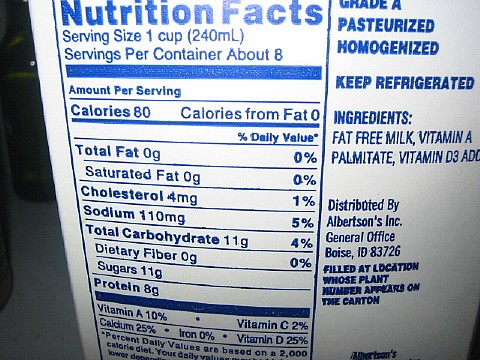
Use the food label image
above to answer the following questions:
1. What is a DV?
___________________________________________________
2. What is the “magic” % DV used in this
class? __________________________
3. Which nutrient(s) on the milk label above
meet the “magic” % DV?
______________________________________________________________
4. How many servings are in the container?
_____________________________
5. How many calories per serving are from
carbohydrates? __________________
6. How many calories per serving are from fat?
___________________________
7. How many calories per serving are from protein?
_______________________
8. How many calories per container
are from carbohydrates? ________________
9. How many calories per container
are from fat? _________________________
10. How many calories per container
are from protein? _____________________
11. Using page 19 of your textbook, are
there any terms that could be used on this food label?
If so, which terms could be used and why?
IV.
Chapter
1: Nutrition & Health Overview
Read chapter 1 in your
text and answer the following questions:
According to the beginning of Chapter 1, good nutrition and
physical fitness are key elements of a healthy ___________ .
What is the purpose of the DRIs?
Which one of the four DRIs is assigned when nutrient needs cannot
be quantified as precisely, but the recommendation is believed to
cover the needs of the population?
Which one of the Dietary Guidelines for Americans listed on pages
5-10
of our text do you find to be the most interesting or surprising
(e.g. Food Groups to Encourage)? Please explain.
According to the “MyPyramid” section of our text, what are the
four emphases of MyPyramid? (Keep in mind the former MyPyramid is now
MyPlate.)
What is the difference between MyPyramid and DASH?
What is the term used to describe the allowance of calories
remaining in a food intake pattern after accounting for the
calories needed for all food groups—using forms of foods that are
fat free or low fat and with no added sugars? (Refer to Table 1.1
on page
15 of your textbook.)
Which nutrients and/or values must
appear on a nutrition label (e.g. total calories, fiber, etc.)?
Nutrition labels must express the Daily Value (DV) in relation
to how many calories per day?
What factors, other than nutritional considerations, influence our
food choices and eating patterns?
Review Table
1-4 on pages 23-30 of the textbook. Based on food
practices of different cultures, what are some of the health
implications different cultures have in common?
Digestion is synonymous with what word(s):
According to Figure 1-3, which of the following statements is
true:
- The dietary constituents, or energy-yielding
macronutrients, include triglycerides, proteins and
carbohydrates, which must be digested before they can be
absorbed.
- The brush boarder absorbs triglycerides, proteins, and
fiber.
- Amino acids and monosaccharides travel to the blood
stream by first going through the lymphatic system.
Based on the “Digestion and Absorption” section of our text, define each of the following:
|
DEFINITION
|
a. Carbohydrate
|
compounds
composed of single or multiple sugars, (C, H, O)
|
b. Polysaccharide
|
many
monosaccharide units, such as starch
|
c. Monosaccharide
|
|
d. Oligosaccharide
|
|
e. Disaccharide
|
|
f. Simple sugar
|
|
g. Fiber
|
|
h. Protein
|
|
i. Amino Acid
|
|
j. Polypeptide
|
|
k. Dipeptide & Tripeptide
|
|
l. Essential amino acid
|
|
m. Nonessential amino acid
|
|
n. High biological value
|
|
o. Low biological value
|
|
p. Triglycerides
|
|
q. Diglyceride
|
|
r. Monoglyceride
|
|
s. Monounsaturated fatty acid
|
fatty acid with one point of unsaturation (one
double bond)
|
t. Polyunsaturated fatty acid
|
FA with 2 or more points of unsaturation (two or
more double bonds)
|
u. Omega-3 fatty acid
|
|
v. Saturated fatty acid
|
FA with
all the hydrogens it can hold (NO double bonds)
|
w. Vitamin
|
essential,
noncaloric,
organic nutrients needed in tiny amounts
|
x. Mineral
|
essential,
noncaloric,
inorganic nutrients needed in tiny amounts
|
Draw a picture of the digestive tract and include the 6 main
segments, three of which constitute the small intestine.
Damage or surgical removal of the ________________________ often
leads to malabsorption of nutrients due to most absorption taking
place here.
How many out of every ten Americans who die each year die of a
chronic disease such as cancer, cardiovascular disease, or
diabetes?
Choose one of the online nutrition resources
below and answer the questions that follow:
-
Which online resource did you choose?
-
What was the most
interesting or surprising thing you learned? (Be
specific.)
End of Week 1 Unit Preparations
After filling in ALL of the blanks to the
questions above go to the "Orientation Quiz"
and "Unit 1 Study Questions" under Week 1 in Moodle to
submit your answers.
(Note: If you take
either quiz after the due date, please send me a message.
It will probably not be graded
until you do that as I
may not realize it was done. I can do this ONE time.)