
Module Two: Theoretical Approaches to Culture
Lecture A) The Beginnings of Anthropology as a Science.
Lecture B) How Cultures Work: American Anthropologists.
Lecture C) European Schools of Thought.
During this class we will of course be exploring the mysteries behind the religions of other cultures. We will cover intriguing topics such as shamanism and voodoo. We will also discuss language, art, and social inequality. This course is, however, a course in anthropology. We do not merely want to excite our imaginations with thoughts of the supernatural and unfamiliar; we also want to learn how to view cultures from an anthropological perspective.
This module will discuss 1) the history of theoretical perspectives in anthropology, 2) some prominent theories on how cultures work, and 3) how we apply these theories specifically to the topic of cultural systems. This module will also give you an idea of how to collect and record cultural data.
LECTURE A) The Beginnings of Anthropological Thought
The interest in other cultures begins when Columbus "discovers" the "New World" in 1492. Of course many people had made it to the Americas before then. Native Americans traveled here at least by 13,000 years ago, if not earlier. Since then, Russians, Vikings, and Africans (Bower, 2001; Wiener, 1992) have traveled here. So why did Columbus get all the credit? Well, Columbus happens to make his trip after the printing press was invented in Europe by Gutenburg in 1455.
An earlier version of the printing press had been invented in China, but for Europeans, the Gutenberg model had a huge local effect on the availability of information. Gutenburg's printing press was also very economical. Books were now affordable, and the news of Columbus' travels was widely published. (Man 2002)
By the 1600's many people are learning to read. This included groups of people that were not typically literate in earlier times, such as women and the poor. Many books are written about travel to exotic places, and people are interested in reading about strange and exotic places. By the late 1800's there is a professional interest in the study of other cultures.
| |
Darwin |
During the 1850's Charles Darwin publishes "The Origin of Species" describing his theory of natural selection. Darwin is of course referring to biological evolution in his work, but some researchers decide that his theories are applicable to the study of cultures as well. This idea is referred to as CULTURAL EVOLUTION.
E.B. TYLOR, a supporter of cultural evolution, believed that all humans are rational and will always choose to react as rationally as possible. When societies engage in seemingly irrational behavior, it is because they lack the information to make more rational choices. For example, if a culture does not understand how weather works, they may believe that incantations and spells they cast will help to bring about the desired weather conditions. But all cultures will choose the most rational path they can based on the information they have. This perspective was called INTELLECTUALISM.
Tylor saw all societies as being on the same evolutionary path; this idea is called UNILINEAL EVOLUTION. All cultures were capable of achieving rational behavior, some societies were just further behind on the path than others. He of course regarded Europe and England as being at the pinnacle of this evolutionary journey to perfect rationality. But he still believed that his culture had a ways to go. He considered institutions, such as marriage and religion irrational. Tylor felt that the more we learned about our world and the universe, the less we will believe in religion. His idea of a utopia was a society run purely on rational thought.
By today's standards Tylor's theory is backwards, racist, and ethnocentric. But for his time he was actually quite progressive. While he regarded other societies as being less advanced than his own, he did believe that all societies could eventually catch up. He believed that all people, everywhere, were capable of rational thought. Many people of his day did not even consider indigenous peoples of other continents to be human.
In response to the belief in Intellectualism and the idea that humans act rationally, a movement known as ANTI-INTELLECTUALISM began. This was the idea that humans are not at all rational, but instead are motivated, if not ruled by, emotions, social pressure, or simple reflex and instinct.
Examples of famous old dead guys that came out of this movement, are Pavlov and Freud. Pavlov did experiments concerning dogs' responses to stimuli. When dogs see, smell, or eat food they salivate. He rang a bell every time he feed the dogs. After a while all he would have to do is ring the bell and the dogs would salivate. This is called a 'conditioned response'. Pavlov felt that humans also behave according to conditioning they had as children.
Freud stated that he believed that much of human interaction was motivated by an unconscious desire to sleep with the parent of the opposite sex. It is an interesting historical note that Freud himself did not originally believe that this was the cause for some human behavior. He was the doctor of several women who where having difficulty forming healthy, long term relationships and were not comfortable with their sexuality. After talking with these women, Freud decided that these women were suffering because they had been sexually abused as children. This abuse caused them to form unhealthy relationships as adults. When he presented his assessment to the scientific community, people were outraged. We have difficulty discussing sexual abuse even today. Imagine how taboo of a subject it must have been during Freud's lifetime.
Because of pressure from his colleagues, Freud changed his assessment and said that these women were having difficulties adjusting because they had an unconscious desire to sleep with their fathers (Mason, 1984; MacIntre, 1958). A major branch of psychology was based on Freudian theory, and it all started simply because he was under pressure to conform!
Another scientist to come out of Anti-Intellectualism was Franz BOAS. He is famous for his anthropological work, but he actually earned his PhD in Physics, with a minor geography. He traveled to America in the late 1800's to study the geographical knowledge of the Eskimo and to record their seasonal migration patterns. He went on to write documents about the cultures of the Northwest Coast Native Americans, such as the Bella Coola, the Tlingkit, the Kwakiutl, and the Haida (Hatch, 1973).
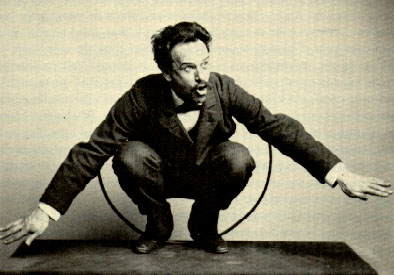 |
Franz Boas demonstrating a Kwakiutl dance |
Because of his work he was offered several appointments at universities. In 1896 he decided to take a position at Columbia University, where he established the first Department of Anthropology in America (Liron, 2003).
Unlike Tylor, he thought human behavior was driven by emotions and sentiment, rather than rationality. Also, he did not believe that cultures were all on the same evolutionary path, but instead have their own unique direction. This theory is called MULTILINEAL EVOLUTION.
Boas called it HISTORICAL PARTICULARISM. It means that all cultures have a unique history of events and encounters with neighboring cultures. For this reason, each culture would develop in a unique way; each culture would manifest itself differently; and each would be headed on it's own individual path.
Franz Boas is more famous, however, for his theory of CULTURAL RELATIVISM. This is the idea that all cultures have valid beliefs systems. And while a particular belief or cultural practice may seem to us to be weird, backwards, stupid, silly, or superstitious; when looked at from the prospective of an insider, it makes perfect sense and fits in naturally with the other beliefs and practices of that culture.
This may seem obvious to 21st century students, but it was a new idea at the time. Most people, including scientists, were racist, ethnocentric, and closed minded by today's standards. Boas got us on the road to reporting on other cultures without using negative, condescending, and judgmental terms like the one's listed in the previous paragraph.
Boas also did his part to fight biological racism. He did studies in physical anthropology to debunk the use of craniometry as a marker for racial inferiority. He measured the heads of 1)adult Native Americans, 2) adult European immigrants, and of 3) the children of those European immigrants, all living in the Minnisota and Wisconsin. He found that the childrens' heads more closely resembled the heads of the Native Americans than those of their own parents!! He thus proved that environment was more of a factor than inheritance in determining head shape.
Boas also started the practice of PARTICIPANT OBSERVATION. This is where the anthropologist not only records, but participates in cultural activities to get a better understanding of a culture. Before Boas, travelers would visit a group for a short time and then come home and write about the culture from an ETIC (outsiders) perspective. By living with a group for months at a time, perhaps over and over again for years on end, and by actively participating in cultural events and daily activities; only then could a researcher hope to gain a more EMIC, insiders, perspective.
Cultural relativism, participant observation, and the quest for an ever more emic perspective, are principles still held near and dear to the hearts of modern anthropologists. In the next lecture we will discuss the more recent developments in anthropological theory and the study of cultures and religion.
DEFINITIONS AND PEOPLE:
TYLOR
INTELLECTIONALISM
CULTURAL EVOLUTION
UNILINEAL EVOLUTION
BOAS
ANTI-INTELLECTUALISM
MULTILINEAL EVOLUTION
HISTORICAL PARTICULARISM
CUTURAL RELATIVISM
PARTICIPANT OBSERVATION
ETIC
EMIC
REVIEW QUESTIONS:
RECOMMENDED VIDEO: If you live near campus, I highly recommend going to the media center to watch a film on 'How Cultures are Studied'. It is Part 3 of the 'Faces of Culture' series (video number 142.01). If you don't live near Foothill, any campus that offers the "Patterns of Culture" course will own this series. Also, you may be able to find it in a video library under the title, 'A Man Called Bee' by Napoleon Chagnon.
Bibliography
Bower, Bruce 2001 Early Brazilians Unveil African Look, Science News Week of April 7, 2001; Vol. 159, No. 14 , p. 212.
Hatch, Elvin 1973 Theories of Man and Culture, Columbia University Press.
Liron, Tal 2003 Franz Boas and the Discovery of Culture, Dept. of Anthropology and Sociology, Amherst College.
Man, John 2001 Gutenberg: How One Man Remade the World with Words, Wiley.
MacIntyre, A.C. 1958 The Unconscious: A Conceptual Analysis. Routledge & Kegan Paul.
Masson, J. 1984 The Assault on Truth: Freud's Suppression of the Seduction Theory. Faber & Faber.
Weiner, Leo 1992Africa and the Discovery of the Americas, Reprinted from original 1922, A & B Books.
 |