
ACTIVITIES AT A GLANCE. Check them off as you complete
them.
| |
By midnight (11:55 pm) SUNDAY, complete Unit 6 Study Questions for 10 points (be certain you've FIRST done ALL of the Unit Preparation Questions below). (If you have any questions, post them in our "Forum Week 6" in Moodle.) |
| |
Sometime BEFORE SUNDAY,
participate in our "Forum
Week 6" by making
at least two
postings throughout the week with at least one of the
postings BEFORE Friday evening. So the total MINIMUM is 2
postings on TWO different days. (A posting can be either
posting a question you have or replying to a classmate's
question or comment. You don't have to respond to all of
the threads if you don't feel you have anything to add.
You can also choose to respond more often.) |
OBJECTIVES
After reading the assigned reading, filling out the Unit
Preparations below, participating in the "Forum Week 6", and completing the Unit 6 Study Questions, you will
be able to:
RESOURCES
OPTIONAL RESOURCES
WEEKLY FORUMS:
Each week, there will be a FORUM that will allow you to post any
questions you have
about the lecture or materials covered as well as allow the
instructor to post any changes
or corrections that need to be communicated.
A SQ will ask if you participated at least twice in this week's
forum. (Refer the syllabus for additional details.)
FORUM WEEK 6: (Go
to our Moodle classroom and click on "Forum Week 6" to participate.)
"Student Questions": Do you have any questions about the Unit 6 Preparations? Please post your questions/concerns in the forum for others to be able to respond.
"Ice Creams & Labeling": After completing the Unit
Preparations section about "Carbohydrate Counting" below,
what did you learn from the example of two ice creams? How can you apply this information to your
current eating habits? (Do you buy "sugar-free" versions
of different food items?)
"15-30gm CHO Snacks": Once you've completed this week's Unit Preparations, specifically page 86 of your packet, share a possible daytime or bedtime snack that would be appropriate for someone with diabetes. The snack should be one carbohydrate choice (~15grams of CHO) if during the day and two carb choices if before bedtime. The snack should also include a food that is also good source of protein.
CORRECTIONS / CLARIFICATIONS: (Please check our weekly forum for additional corrections and clarifications.)
The following topics will be covered this week:
I. Chapter 17: Diabetes Mellitus
Read chapter 17 in your text and
answer the following questions:
OVERVIEW OF DIABETES
Diabetes is seen in three
primary forms:
Diabetes is a group of diseases characterized by hyperglycemia (high blood glucose levels) as a result from no insulin being secreted by the pancreas, or a defect in insulin action, or both.
Without sufficient insulin, or a cell’s resistance to insulin, hyperglycemia occurs. High blood glucose results because insulin is the key that opens the door within cells for glucose to enter. Without insulin, glucose remains elevated in the blood. Hyperglycemia results in both short-term and long-term complications. Some acute, life-threatening consequences include ketoacidosis and nonketotic hyperosmolar syndrome. The long-term complications that arise from diabetes result from the blockage or destruction of capillaries that feed vital organs and tissue, and this causes the tissue to die from lack of nourishment. Problems include impaired circulation to extremities often leading to amputation, kidney and cardiovascular disease, impaired vision or blindness, nerve damage, and skin problems.
In 2007, the Centers for Disease Control and Prevention released data stating that 24 million Americans have diabetes and are estimating that another 57 million Americans have prediabetes. Type 2 diabetes is the most prevalent type of diabetes, and it is a progressive disease that is often present long before it is diagnosed. There are many risk factors associated with type 2 diabetes including weight and family history. Click on the below link to assess your risk for diabetes.
What was your risk level and what were your risk factors according to the diabetes risk calculator?
Diagnosis of Diabetes (Pg. 448 in text)
· Plasma glucose level of ______ mg/dl or higher PLUS ____________ of diabetes, which include: polyuria (excessive urination), polydipsia (excessive thirst), and unexplained weight loss.
· Fasting plasma glucose level of _______ mg/dl or higher.
· Plasma glucose level of _______ mg/dl or higher 2 hours after an oral glucose tolerance test.
Classification of Diabetes (Pg. 448-449 in text)
Of the three types of diabetes listed above, which one is the most prevalent amongst adults?
Prediabetes and Diabetes Prevention (Pg. 449 in text)
What kind of diet and lifestyle changes should a prediabetic be encouraged to make?
Complications of Diabetes (Pg. 449-450 in text)
What are some similarities and differences between DKA and HHNS?
Click on the following link: Diabetes Complications to read more about how the heart, kidneys, eyes, and nerves can be affected by diabetes.
What complication did you read about? What did you learn that was new or interesting?
Treatment Goals (Pg. 450-459 in text)
Diabetes is a chronic disease that
requires lifetime
changes in lifestyle since the management of diabetes depends on
diet, exercise, and medications. The healthcare team
(physicians, nurses, dietitians, and other health professionals)
provides the diabetic with the tools needed to achieve the best
possible control of carbohydrate, protein, and fat metabolism to
prevent complications.
The patient and family must be
able to understand and carry out the treatment with a great deal
of ______________________.
Planning of care begins with
_____________________ measurements and a thorough _________________ and
___________ history to assess the person's usual patterns.
Fill in the following values using Table 17-1 on pg. 454. (These are a summary of treatment goals by the American Diabetes Association (ADA) for adults with diabetes.)
The A1C test is the primary target for glycemic
(blood glucose) control, but what exactly is the A1C?
Click on the following link: FACTS
ABOUT
A1C to answer the below questions about A1C.
Medications
What affect do insulin sensitizers, insulin secretagogues, and incretins have on blood sugar levels?
What are the 2 risks of intensive glycemic control (mentioned on pg. 456 in text)?
NUTRITION ASSESSMENT AND CARE (Pg. 459-464 in text)
Self-monitoring of blood glucose (SMBG)
Medical Nutrition Therapy Goals
· “A”: Keep your A1C under 7%.
· “B”: Maintain your Blood pressure in the
normal range (120/80).
· “C”: Manage your Cholesterol with LDL (bad
cholesterol) <100mg/dl.
What information should be included in a basic patient education program?
Nutrition Guidelines
Nutrition therapy is an essential component of diabetes management. People with diabetes usually have the same nutritional requirements as the general population. Therefore, the dietary recommendations to promote health (lose weight if overweight, eat less saturated fat and cholesterol, eat more fiber and less sodium) in the general population are also appropriate for people with diabetes. Since diabetics are at an increased risk for coronary heart disease (coronary heart disease is the leading cause of death amongst people with diabetes) the nutrition recommendations issued by the ADA to prevent and treat diabetes are similar to the recommendations made by the American Heart Association (AHA) to prevent heart disease.
Energy Balance
Explain why a high-protein, low-carbohydrate diet is not recommended for people with diabetes?
Carbohydrate
There are many misconceptions that diabetics have about carbohydrates. The muddiest points I have found diabetics to have is confusion about where you find carbohydrates in foods, and how much carbohydrate they should be consuming. There is a lot of education that needs to take place between the diabetic patient and the nutrition support staff about carbohydrates because this is one of the cornerstones in treatment for managing blood glucose levels. Here are some main points that diabetics should know about carbohydrates:
· Carbohydrates will account for _____ % or more of Calories consumed in a day. (Many diabetics are surprised their carbohydrate intake can be so high.)
· Foods that contain carbohydrate are needed for energy. Carbohydrates break down into glucose and will raise blood sugar. Carbohydrates from any food will have the same effect on blood glucose.
· The source of carbohydrate is not as critical as the total amount of carbohydrate consumed at a meal or snack. Substantial evidence from clinical studies shows that when sucrose is substituted for starch (at the same calorie level) there is no difference in glycemic control. Sucrose and sucrose-containing foods do not have to be restricted but should be substituted for other carbohydrate containing foods, not eaten as "extras". Care should be taken when choosing foods high in sugar as they are usually nutrient poor and may also be high in fat which can lead to excess Calorie intake.
· Carbohydrates should be spread as _________ as possible across meals.
· Eat healthy, well-balanced meals 4-5 hours apart on a regular schedule.
· Carbohydrates with fiber should be a focus. At least ______ to _____ g of fiber daily is recommended, with even higher recommendations for men.
· Sugar alcohols are often used in diabetic foods, but be careful because excessive amounts can cause ___________ (pg. 462 in text).
· Special diabetic foods are not necessary, and a wide variety of whole foods can make up a healthy diabetic diet.
· Nonnutritive sweeteners (aspartame, acesulfame K,
sucralose, and saccharin) do not affect blood glucose levels. (Refer to the optional
resources above for more information.)
· Utilizing the glycemic index to decrease one's risk of disease still remains uncertain.
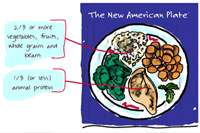
· Monitoring of carbohydrates will depend on the skills and interest of the diabetic. The following are some of the most commonly used methods:
1. Exchange lists
2. Carbohydrate Counting
3. Plate Method
1. Exchange Lists
Choose Your Foods: Exchange Lists for Meal Planning was devised by the American Diabetes Association and the American Dietetic Association as a framework for choosing a healthy diet that groups foods based on their nutrient content. Per serving, foods are similar in carbohydrate, protein, fat and calories. A sample meal pattern can be created for clients based on their usual pattern of eating using the lists. For each meal and snack the number of exchanges from each list is specified. Clients can use the list to choose the appropriate types and amounts of food allotted. The exchange list approach is best suited to people who want or need a structured meal plan and are able to understand complex details.Click on the following link to look at how different foods are categorized within the exchange list and answer the questions below: Exchange Lists
Which groups do not contain carbohydrates or minimal carbohydrates (5g or less per serving)? (Note: The website did not list the carbohydrate content for the milk group, but if you look at the milk label that was included in week 1 preparations, you will see that milk has about 12g of carbohydrate per cup.)
Which groups contain 15g of carbohydrate per serving (and therefore count as a carb choice)?
Which of the following types of foods are listed in the starch group?
a. grains
b. beans or legumes
c. non-starchy vegetables
d.
starchy vegetables (e.g. corn, potato, peas)
According to the food lists, ½ c. carrots would have ____g of carbohydrate, and ½ c. corn would have _____ g of carbohydrate.
List some of the foods that fall into each of the groups:
Vegetables-
Milk-
Protein-
Fruits-
Starches-
Fats-
The above link is a summary, not a detailed list of the exchange lists. If you are interested in seeing a more detailed list click on the following link:
2. Carbohydrate Counting
Carbohydrate counting is gaining
popularity as an easier and more flexible alternative to exchange lists. Based on a client's usual pattern of eating and daily
calorie allowance, clients are given an individualized meal
pattern that specifies the number of carbohydrate "choices" (1
choice = 15g of carbohydrate). In general, most women
need 3-4 carb choices (45-60 grams of carbohydrates) per
meal. Men need 5-6 carb choices
(75-90 grams of carbohydrate) per meal. A reasonable
snack is one (1) carb choice (15 grams of carbohydrate) during
the day. Two (2) carb choices (30 grams of carbohydrate) at
bedtime.
Note: "Carb choices" are foods that fall into categories that contain 15g of carbohydrate per serving.
To help individuals identify sources of carbohydrates and the appropriate portion sizes, clients are given carbohydrate choice lists, similar to the exchange lists, but generally focused specifically on carbohydrates, not protein or fat. Clients will also need to learn to read food labels to accurately count carbohydrates.
When determining how much carbohydrate a food contains look at the total carbohydrate per serving, which includes sugar, starch, and fiber. Check the grams of fiber per serving. If a serving provides >5 g total fiber, subtract 1/2 the total grams of fiber from the grams of carbohydrates. If the food contains sugar alcohols, half of the total grams of sugar alcohols can be subtracted from the total carbohydrate. If more than one serving is consumed, the carbohydrate must be adjusted accordingly.
Compare the carbohydrate content of the following two ice creams:
|
Ice-cream |
Quantity |
Total Calories |
Total Carbohydrate |
Total Fiber |
|
Chocolate Fudge, Fat Free, No Sugar Added |
½ cup |
100 |
22g |
0g |
|
Chocolate |
½ cup |
143 |
19g |
1g |
Which ice cream has the least
amount of carbohydrate?
Are you surprised by these
findings?
What can you learn from this example?
3. Plate Method
Protein
Fat
Alcohol
Vitamins, Minerals and Sodium
Often people seek alternative therapies for managing their health conditions. One alternative therapy popular amongst diabetics is chromium supplementation. Click on the following link to learn more about chromium.
Physical Activity
Pregnancy and Lactation
An infant of a diabetic in poor control at the time of conception is at risk for malformations or _________.
Infants of diabetic women are at increased risk of ______________, respiratory distress syndrome, and excessive body size.
Coping with Acute Illness
True or False:
It is not recommended to take insulin or other hypoglycemic
medications when sick.
What is
recommended when a diabetic becomes sick?
Hypoglycemia
Blood glucose of < _____ mg/dL
Can occur in both type 1 and type 2 diabetics
What are the factors that can cause hypoglycemia?
What are some signs and symptoms of hypoglycemia?
How can hypoglycemia be corrected?
Diabetic
Gastroparesis
What is
diabetic gastroparesis?
What medical
nutrition therapy is recommended for an individual with
gastroparesis?
Using the Diet Manual
Read about The Reduced Concentrated Sweets Diet (RCS) and The
Controlled Carbohydrate Diet (CCHO) in the
diet manual,
IMPAC
(pgs. 45 & 46) and answer the questions below:
How are the RCS diet and the CCHO diet similar and
different?
Which diet do you think would be most appropriate
in a long-term care setting? Why?