
Guide to Physical Therapy Practice Patterns
Neuromuscular Practice Patterns in Physical Therapy

The Guide to Physical Therapy Practice frames seven, impairment-based patterns that are consistent with patients and clients encountered in the physical therapy service. The language in practice patterns reflects the commitment to documenting and tracking how a person functions within their disease versus focusing on the disease.
Physical Therapy practice patterns connect affected body structures and functions with outcomes in the examination process. The result is a clear application of the International Classification of Functioning, Disability, and Health (ICF) which aids in evidence-based treatment planning. Within practice patterns, the physical therapist evaluates how body systems and conditions and the associated impairments impact function and disability within the patient's individual circumstance.
The table below outlines how physical therapy approaches establishing a PT diagnosis. A PT prognosis will factor in specific patient situations and circumstances (such as co morbidities, support systems, etc., work/home activities) in order to set treatment goals, frequency and duration.
|
Practice Pattern |
Practice Pattern Description |
Example Diagnoses |
|
Pattern A
|
Impaired Motor Function and Sensory Integrity Associated With Congenital or Acquired Disorders of the Central Nervous System in Infancy, Childhood, and Adolescence
|
Cerebral Palsy (CP) Spina Bifida Myelomeningocele Spastic Hemiplegia Spastic Diplegia Epilepsy Autism Spectrum Disorders Fetal Alcohol Syndrome |
|
Pattern B
|
Impaired Motor Function and Sensory Integrity Associated With Acquired Non progressive Disorders of the Central Nervous System in Adulthood
|
Traumatic Brain Injury (TBI) Cerebral Vascular Accident (CVA) Transient Ischemic Attack (TIA) Burns |
|
Pattern C
|
Impaired Motor Function and Sensory Integrity Associated With Progressive Disorders of the Central Nervous System in Adulthood
|
Multiple Sclerosis (MS) Amyotrophic Lateral Sclerosis (ALS) Parkinson's Disease (PD) Myasthenia Gravis Huntington's Disease Alzheimer's Disease |
|
Pattern D
|
Impaired Motor Function and Sensory Integrity Associated With Peripheral Nerve Injury
|
Ischemic compression stretch inflammation chemotoxicity |
|
Pattern E
|
Impaired Motor Function and Sensory Integrity Associated With Acute or Chronic Polyneuropathies
|
Guillain-Barré Syndrome (GBS) Autoimmune diseases Diabetic Neuropathy Alcoholism Nutritional Deficits (e.g, B12) Infection (Herpes, Polio) |
|
Pattern F
|
Impaired Motor Function and Sensory Integrity Associated With Non progressive Disorders of the Spinal Cord
|
Spinal Cord Injury (SCI) Degenerative Joint/Disc Disease in Spine |
|
Pattern G
|
Impaired Arousal, Range of Motion, Sensory Integrity, and Motor Control Associated With Coma, Near Coma, or Vegetative State
|
Minimally Responsive State Anoxic Brain Injury Toxicity or Metabolic Dysfunction |
Coordinating Care
Many providers are involved in coordinating care for patients and clients with neuromuscular dysfunction. All health care providers share a commitment to patient and family education and patient-centered practice. Examples of providers and some of their focused scope of practice include:
- Physiatry - physical medicine and rehabilitation doctors
- Neurologists - physicians that specialize in the brain and nervous system
- Neurosurgeons - surgical procedures to protect optimize function of the nervous system
- Neuropsychologists - provide therapeutic intervention and assessments of cognitive functioning
- Speech language pathologists - provide therapeutic interventions for improving swallowing, speech production (quality, fluency), and communication/problem solving
- Occupational therapists - provide therapeutic interventions for improving activities of daily living and self-care activities, community reintegration, and fine motor skills
- Respiratory Care- provide therapeutic interventions to support respiratory function and ventilation
- Nutritionists - provide dietary guidelines and monitoring of nutritional status and weight based on condition
- Nursing - provide round-the-clock care and monitoring of physiological status and provide interventions, medications to stabilize and improve health condition per physician orders
- Therapeutic recreation therapists - provide interventions that foster enjoyment and positive interactions and self-efficacy
- Chaplains - provide spiritual support to patients and families on areas of personal need and in adjustment to disability
- Radiology - provide imaging studies that inform the team of anatomical, physiological, and pathophysiological status in multiple body systems
PT Examination
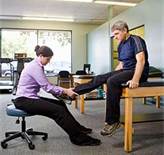
Image is of a PT evaluating a pt with a
neurological condition

Key elements of a physical therapy examination includes
- Cognitive or Mental status screening
- consciousness, attention, orientation, and general cognition (e.g., memory, information processing)
- Communication
- includes speech and language disorders
- Motor control
- volitional versus involuntary movements, isolated or synergistic
- Motor learning
- ability sustain motor performance over time, interpret motor feedback, transfer skills to different environments
- Postural control, balance and coordination
- Coordination
- muscle activity during voluntary movement
- muscle groups working together to perform a task (timing, accuracy, sequence) = synergy
- level of skill and efficiency
- start, control and stop according to activity/environment demand
- Gait and Locomotion
- Neuromuscular tone
- Range of Motion and Flexibility
- Integument integrity
- skin observations, pressure areas
- Pain
- Sensation and Sensory Integration
- deep tendon reflexes (DTRs)
- pathological reflex testing
- proprioception
- kinesthesia
- sensory discrimination (sharp & dull, hot & cold, vibration, light touch & pressure, right & left discrimination)
- Cranial nerve integrity
- Peripheral nerve conduction / electromyography (EMG)
- Manual Muscle Testing
- Functional Task and Mobility Analysis
- Protective and Support Equipment
- Standardized Outcome Measures
- Functional Independence Measure (FIM)
- Performance Oriented Assessment of Mobility (Tinetti)
- Functional Reach Test
- Timed Get Up and Go Test
- Timed Walking Test
- Berg Balance Scale
- Barthel Index
- Aerobic Capacity and Endurance

Summary of Patient-Client Management for Patients and Clients with Neuromuscular Conditions
- PT examination
- Review of history, reason for referral, review of systems, tests and measures, special tests, review of diagnostic studies (outcomes of imaging, lab results)
- PT Evaluation
- Interpret examination findings and apply clinical reasoning
- Considers personal and contextual factors
- Differentially diagnose and make appropriate referrals as needed for coordinating care
- PT Diagnosis
- Select practice pattern(s) that reflect a neuromuscular pattern within the scope of practice
- PT Prognosis
- Generate goals and expected outcomes; includes a plan of care (interventions, frequency, duration) to achieve goals
Role of the PTA
- Prepare for safe and effective interventions by thoroughly reviewing the PT Examination findings, associated progress reports, and the plan of care
- Recognize declines in function or abnormal responses to interventions and report findings to the supervising PT
- Perform interventions within the POC to achieve stated goals
- Monitor and report physiologic responses to interventions
- Assess motor control and motor learning: report to PT if steep or gradual decline in this area is observed.
- Assess cognitive status: orientation to place, person, time of day, year: communicate to PT and or care team significant changes in this area.
- Communicate barriers, questions, and concerns to the supervising physical therapist
- Complete and repeat tests and measures as indicated to monitor patient response and progress
- Educate patients and family members in use of positioning, equipment, assistive devices, energy conservation, home and community safety (including fall prevention)
- Include age-appropriate and instructional strategies consistent with the patient's developmental and cognitive status
- Coordinate with the interprofesional health care team to optimize safety and recovery
Interventions
- Skilled services selected to progress patient toward goals
- Performed by the PT or the PTA as directed by the supervising PT
- Examples include
- therapeutic exercise (ROM, strengthening, stabilization, postural exercises, endurance training)
- biophysical agents (modalities)
- therapeutic activities (functional training, family training, transfer training)
- gait and locomotion
- training in the use of orthotics, prosthetics, and equipment / assistive technology
- static and dynamic balance and coordination training
- gross motor control and learning
- sensory training
- positioning for pain relief and pain management
- skin care and protection
Tests and measures
Tests and measures provide data that informs the physical therapy plan of care. Outcomes of tests and measures may prompt communication with the supervising PT and other health care personnel, particularly when there are marked changes over time that suggest a need for care plan review or emergency action. Examples of common tests and measures in this population include:
- ROM, strength, functional performance, observation (e.g. posture, skin)
- Pain scales, tone, reflexes, sensation
- Coordination
- Time, distance, quality, assistive devices, cuing, patient support equipment during gait and locomotion
- Physiological responses to movement (vital signs) and endurance
- Orientation (A&O)
- Motor planning and performance - simple to complex movements and associated problem-solving during movement
- Pain management effectiveness
- Standardized functional assessments
- Functional Independence Measure (FIM)
- Modified Ashworth Scale - assesses level of hypertonicity
- Barthel Index - grossly assess activities of daily living functional status
- Specific tests for neurologically-involved patients are covered in PTA 204/204L

Image is of an adult with a spinal cord injury
Functional Independence Measure (FIM): Review from Fall term
|
The Functional Independence Measure is an interdisciplinary measure of function. It may be scored entirely by a nurse from information provided in the medical record and treatment notes.
Typically, the PT team member will be responsible for rating mobility and locomotion. Nursing and/or nursing will rate the self-care items. Nursing or speech language pathology will rate communication problems and cognitive function. Psychosocial status may be a collaborative process and based on consensus from team members.
Levels of Assistance |
||||
|
LEVEL |
ABBREVIATION |
FIM LEVEL |
DEFINITION |
NO HELPER |
|
Complete Independence |
I |
7 |
All tasks are performed safely without modification, assistive devices or aids and within reasonable time |
|
|
Modified Independence |
Mod. I |
6 |
One or more of the following are true about the activity: --requires assistive device --takes more than reasonable time --there are safety (risk) concerns |
|
|
Stand by Assistance
Supervision or Set-up |
SBA Or S |
5 |
Requires no more than standby, cueing or coaxing without physical contact or helper sets up needed items or applies orthoses |
HELPER |
|
Contact guard assistance |
CGA |
4 |
Variation of minimal contact assist where subject requires contact to maintain balance or dynamic stability |
|
|
Minimal contact assistance or minimal assistance |
Min contact A Or Min A |
4 |
Requires no more than touching & expends 75+% or more of the effort; assistance is needed to lift one limb |
|
|
Moderate assistance |
Mod A |
3 |
Requires more help than touching or expends 51% to 75% of the effort; assistance is needed to lift two limbs |
|
|
Maximal assistance |
Max A |
2 |
Subject expends 26% to 50% of effort |
|
|
Total assistance |
Total A |
1 |
Subject expends less than 25% of effort; two or more provide assistance |
|
